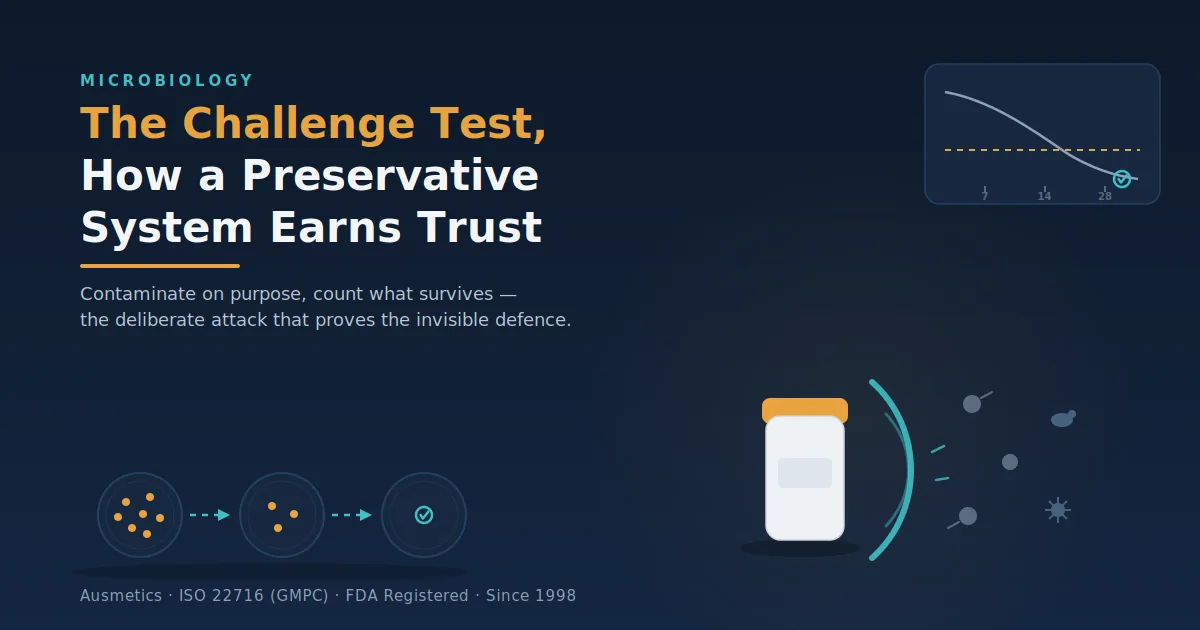
A challenge test — formally, preservative efficacy testing — deliberately inoculates a cosmetic product with microorganisms and then counts them over time, to prove the preservative system can suppress what everyday use will inevitably introduce. Of the three stabilities a product must hold, this is the silent one. A split cream announces itself on sight; a weakening preservative system says nothing at all — until the moment it matters most.
Our stability guide called microbiological stability a subject deserving its own article. This is that article. And its central idea belongs to the standard itself: ISO 11930, the international method for evaluating a cosmetic's antimicrobial protection, frames that protection as coming from sources that span chemical preservation, the formulation's inherent characteristics, Paketdesign, and the manufacturing process. Mit anderen Worten: a preservative system is a system, not an ingredient. The challenge test is where the whole system, not one molecule, earns its trust.
This guide explains the proof from the factory side — the side whose microbial-challenge laboratory runs these studies: why contamination is simulated on purpose, how the test actually works, why retailer ingredient lists have turned preservation into an engineering discipline, and how a buyer should read the report that comes back.
ICH. Why Contaminate on Purpose
Because the customer will. A jar is opened and a finger goes in; shower water splashes into a bottle; a pump sits warm and damp on a bathroom shelf for a year. The PAO figure on an EU label — how long a product stays safe after first opening — is, at heart, a microbiological promise: opening introduces contamination, and the preservative system has to keep handling it for months of real life. The challenge test simulates that future in advance, under control, where a failure costs a reformulation instead of a recall.
The stakes justify the method. Physical failures are visible and chemical failures are measurable, but microbial failures are invisible right up until they are harmful — which is why this is the one dimension of stability that is proven by deliberate attack. The product is contaminated on purpose, and the system is watched while it fights.
II. How the Test Actually Runs
Underneath the microbiology, the structure is simple — a controlled fight with a scoreboard:
| Schritt | What happens | What it tells you |
|---|---|---|
| Baseline check | The product's starting microbial quality is confirmed before anything is added | The test will measure the system's performance, not pre-existing contamination |
| Inoculation | Samples are charged with a standard panel of five organisms — S. aureus, E. coli, P. aeruginosa, C. albicans, and A. brasiliensis — at concentrations the standard defines | Bacteria, a yeast, and a mould: the realistic spectrum of what use lets in |
| Timed counts | Survivors are counted at set intervals across roughly a month — typically days 7, 14, und 28, with earlier points in some schemes | Whether the system kills quickly, holds its ground, or quietly loses it |
| Reduction versus criteria | The measured log reductions are compared against the standard's published acceptance criteria | Pass, pass with documented justification, or back to the formulation bench |
Two refinements matter in practice. Erste, the criteria come in two levels: the standard's criterion A represents the recommended level of efficacy, while criterion B is acceptable where a documented risk assessment justifies it — so "passed" is not one word but a choice with a reason attached. Zweite, the method has siblings: accredited laboratories run challenge testing under ISO 11930, the US Pharmacopeia's chapter, or the European Pharmacopoeia's, and the schemes differ in sampling times and acceptance criteria even though the goal is shared. A report that says "passed a challenge test" without naming the scheme and version has not finished its sentence.
III. Preservation Engineering in the Age of the List
The law draws the first boundary: the EU Cosmetics Regulation runs a positive list — only preservatives on its Annex V may be used at all. Then the retail programmes we mapped in Listen verbotener Stoffe cut deeper: preservative families that remain legal within limits — propyl- and butyl-parabens among them — were targeted for removal by retailer chemical policies that no statute demanded. Every exclusion narrows the toolbox, and the toolbox was never large.
This is why modern preservation is engineering rather than selection, leaning on every source of protection the standard's framing names:
| Source of protection | What it looks like in practice |
|---|---|
| Chemical preservation | Smaller doses of multiple compatible actives working in synergy, instead of one heavyweight molecule |
| The formulation itself | pH set where microbes struggle, water activity kept low, ingredients chosen to starve growth rather than feed it |
| Package design | Airless pumps and narrow orifices that let far less of the world in than an open jar ever will |
| The manufacturing process | Hygiene, Wassersysteme, and controls that hand the preservative system a clean starting line |
The challenge test is where the rebuilt system proves it still works. A "free-from" preservation story that has not survived deliberate inoculation is a marketing claim; one that has is a safety file.
IV. Calendar, Boundaries, and the Factory
In a disciplined programme the challenge test runs alongside the ageing work we mapped in Prüfung der kosmetischen Stabilität, and many protocols repeat it on aged samples — because a preservative system can weaken as the formula around it ages, and the promise has to hold at the end of the shelf life, not just at the start. The boundaries are drawn by the standard itself: the method is designed primarily for water-containing products, and formats whose microbiological risk is determined to be low — the standard points that determination to ISO 29621 — can justify exemption through a documented risk assessment. The exemption is an argument someone signs, not a shortcut someone takes.
Change discipline closes the loop: swapping a preservative is a major-tier change in any serious tier map, and its equivalence bridge includes a fresh challenge test — paper comparison cannot prove a kill curve. Bei Ausmetics, that work runs through a dedicated microbial-challenge laboratory, one of four in-house labs, alongside the routine microbiological control that its Qualitätskontrolle system applies batch by batch. Für ein OEM cosmetics and ODM manufacturer rebuilding preservation systems around ever-shorter ingredient lists, having the attack-and-count loop in-house is what keeps that engineering inside the development calendar.
V. Reading a Challenge Report Like a Buyer
In our experience serving brand and retail programmes, five questions separate a report from a stamp. Which scheme and version — ISO 11930, USP, EP — because they differ, und "passed" is meaningless unnamed. Which criterion — A, or B with its written justification, because the letter is a decision, not a grade. Was the full organism panel run, plus any additions the product's use demands. Which time points were actually sampled, on which formula version, in which packaging context. And what is the policy when a test fails — the reformulation loop and retest evidence, because a preservation history with no failures on record is a filing system, not a track record.
A one-line "challenge test passed" is a stamp. A report you can interrogate is a system earning its trust in front of you.
Häufig gestellte Fragen
Does every cosmetic product need a challenge test?
Water-containing products generally do — water is what makes a formula habitable. Formats whose microbiological risk is genuinely low — anhydrous products, very high alcohol, extreme pH — can justify exemption through the documented risk-assessment route the standard itself references. The key word is documented: the exemption is a signed argument in the safety file, not an assumption made at the bench.
What is the difference between ISO 11930 and the pharmacopoeia methods?
The goal is shared; the schemes are not. ISO 11930 and the US and European pharmacopoeia chapters use overlapping organism panels but differ in sampling times and acceptance criteria, so a formula can satisfy one scheme and fall short of another. That is why buyers ask for the scheme and version by name — and why factories serving several markets keep the differences mapped instead of treating "Herausforderungstest" as one thing.
If a product passes the challenge test, is it protected forever?
No — the pass proves the system as formulated, verpackt, and manufactured at that time. Ageing can weaken preservation, a new pack changes the exposure, a formula adjustment changes the chemistry, and a process change can change the starting bioburden. Disciplined programmes therefore re-test on triggers and pair the challenge test with routine microbiological QC on every batch, so the proven system stays the shipped system.
Does changing the preservative mean redoing the test?
Ja. A preservative swap changes the exact function this test exists to prove, so the equivalence bridge for it includes a fresh challenge test alongside stability bridging — a specification comparison alone cannot demonstrate a kill curve. In tier-map language it is a major change: customer approval before implementation, evidence before shipment, and the first batches under the new system identified as such.
Fazit und nächste Schritte
The challenge test is the quiet counterpart to every visible promise on a label: the deliberate attack that proves the invisible defence. Its logic is the standard's own — protection comes from the chemistry, the formulation, the pack, and the process together — and in an era when retailer lists keep shrinking the chemical toolbox, the test is where re-engineered systems show they still hold. Trust here is not claimed; it is inoculated, counted, and earned.
Ausmetics has been running that proof for 28+ Jahre von seiner ISO entfernt 22716 (GMPC) zertifiziert, Sedex-audited facilities in Guangzhou — a dedicated microbial-challenge laboratory among four in-house labs, preservation engineering built to survive the retailer lists its formulas are screened against, and routine microbiological control on every batch. Marken- und Einzelhandelsentwicklungsteams können unsere überprüfen ODM OEM cosmetics manufacturing services oder Kontaktieren Sie Ausmetics with the formula and the lists it must survive — the reply comes back with a preservation strategy and the test plan to prove it.