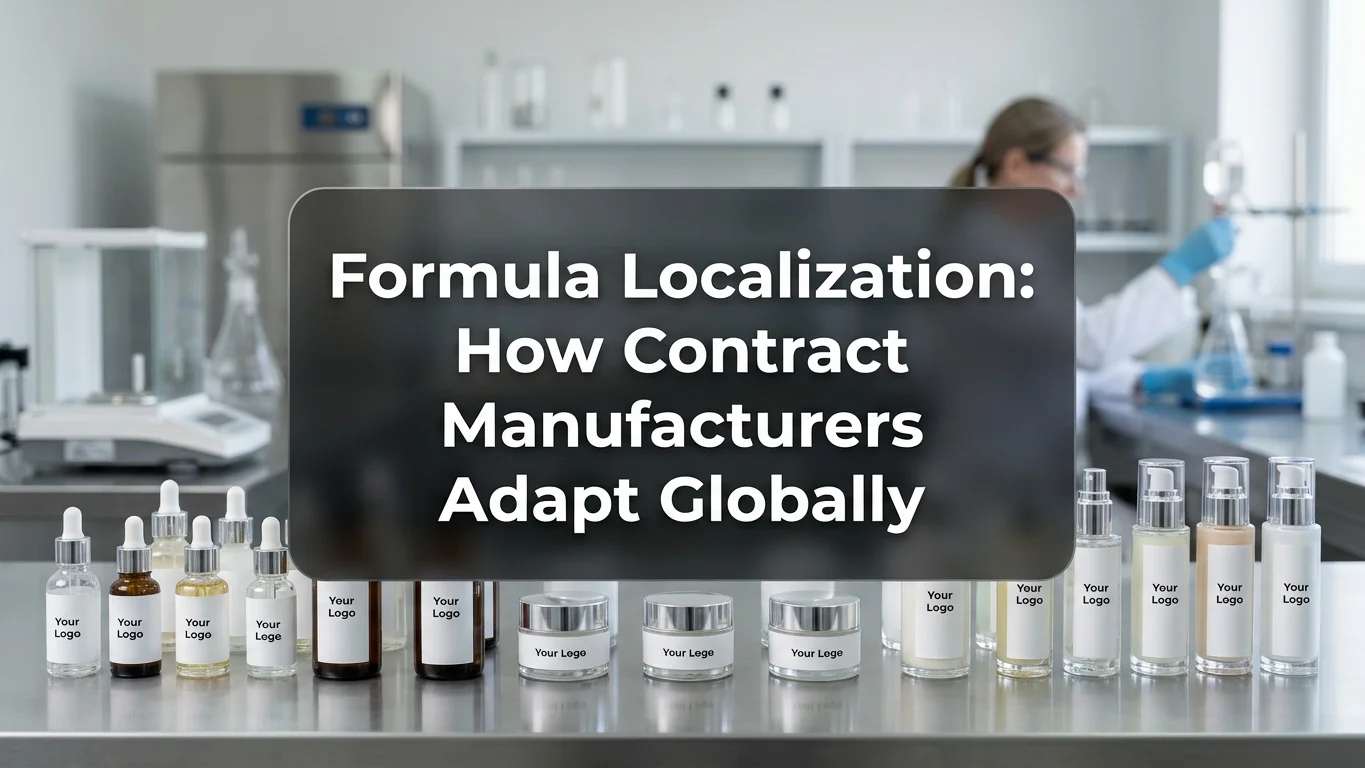
Selling a single skincare product across the United States, האיחוד האירופי, יפן, and ASEAN nations sounds straightforward — until you discover that the preservative keeping your formula shelf-stable in Texas is banned in Brussels, and the UV filter that clears EU review faces a completely different regulatory pathway under the U.S. FDA’s MoCRA framework. For beauty brand founders and Amazon FBA sellers eyeing international growth, formula localization is the hidden operational challenge that determines whether a global launch succeeds or stalls. בעל יכולת יצרן חוזה קוסמטיקה solves this by engineering one flexible base formula — then systematically adapting it for each target market’s regulatory, ingredient, ודרישות תיוג.
This guide explains exactly how that process works. You will learn which ingredients face restrictions across major markets, how preservative systems and active concentrations get adjusted without starting from scratch, and why working with a single multi-market manufacturer can save brands 40–60% on R&D costs compared to managing separate regional production partners. Whether you are preparing your first international expansion or optimizing an existing multi-country supply chain, this framework will help you make informed decisions about formula localization strategy.
The information here draws on current regulatory frameworks including the FDA’s Modernization of Cosmetics Regulation Act (MoCRA) ו EU Regulation EC 1223/2009, along with ASEAN Cosmetic Directive guidelines — the three regulatory pillars that govern the vast majority of global beauty commerce in 2026.
אני. Why One Formula Cannot Ship Unchanged to Every Market
Brand founders often assume that if a product is safe and effective, it can be sold anywhere. במציאות, cosmetics regulation is intensely local. The same ingredient may be permitted at 1% concentration in one country, restricted to 0.5% in another, and outright prohibited in a third. These differences are not theoretical — they directly affect whether your product clears customs, passes post-market surveillance, or triggers a forced recall.
א. The Regulatory Fragmentation Problem
Consider a common scenario: a vitamin C serum formulated with 15% חומצה L-אסקורבית, preserved with methylisothiazolinone (מִי), and containing a popular chemical UV filter. Under MoCRA in the United States, sunscreen actives are regulated as over-the-counter drugs, requiring separate monograph compliance. The EU restricts MI in leave-on products entirely. And several ASEAN member states maintain their own positive lists for UV filters that differ from both the FDA and EU frameworks.
Without a localization strategy, a brand would need to develop three or four entirely separate formulations — each requiring independent stability testing, הערכות בטיחות, and manufacturing runs. This multiplies costs, fragments inventory, and creates quality-control complexity that most indie and mid-size brands cannot absorb.
ב. The Base-Formula Approach
The solution used by experienced multi-market manufacturers is a modular base-formula architecture. This means designing one core formulation — the emulsion system, key actives, texture profile, and fragrance — that is inherently compliant with the strictest common standards. Market-specific adjustments then occur only at the component level: swapping a restricted preservative, adjusting an active concentration, or replacing a single UV filter. The base stays intact. The modifications are surgical.
יתרון Ausmetics: עם 28+ years of cosmetics contract manufacturing experience and an FDA-registered, ISO 22716-certified facility in Guangzhou, אוסמטיקה supports formula localization across 20+ global markets. ה-R של החברה&צוות D - בראשות ד"ר. ג'דיר נונס, former IFSCC Global President — designs base formulations with modularity built in from the start, so regional adaptations require minimal reformulation while maintaining consistent product performance.
II. Ingredient Substitution Across Major Regulatory Frameworks
The most common localization adjustments involve three ingredient categories: חומרים משמרים, מסנני UV, and functional actives. Understanding what changes — and why — helps brand founders anticipate costs and timelines before production begins.
א. Preservative System Adaptation
Preservatives are the single most frequently adjusted ingredient class in global formula localization. The EU’s strict approach under EC 1223/2009 has effectively eliminated several preservatives that remain permitted in the U.S. וחלקים של אסיה.
| מְשַׁמֵר | לָנוּ. (FDA/MoCRA) | האיחוד האירופי (EC 1223/2009) | ASEAN | Common Substitution |
|---|---|---|---|---|
| מתיליסותיאזולינון (מִי) | Permitted in rinse-off and leave-on | Banned in leave-on products | מוגבל; varies by member state | פנוקסיאתנול + ethylhexylglycerin blend |
| Formaldehyde releasers (DMDM הידנטואין) | Permitted with labeling | Heavily restricted; concentration limits | Generally restricted | Sodium benzoate + potassium sorbate system |
| פרבנים (מתילפרבן, פרופילפרבן) | Permitted | Permitted with concentration caps (0.4% single / 0.8% mixtures) | Permitted with concentration caps | Multi-hurdle preservation (ph + פעילות מים + קלציה) |
| פנוקסיאתנול | Permitted up to 1% | Permitted up to 1% | Permitted up to 1% | Universally accepted; often used as base preservative |
A skilled manufacturer designs the base formula around phenoxyethanol or another globally accepted preservative, then adds supplementary antimicrobial agents only where regulations and climate conditions require enhanced protection. This avoids the need for separate stability studies for each market’s preservative system.
ב. UV Filter and Sunscreen Active Adjustments
Sunscreen ingredients present the most complex localization challenge because the regulatory classification differs fundamentally between markets. בארה"ב, sunscreen actives are regulated as drugs under the FDA’s OTC Monograph system. באיחוד האירופי, they are regulated as cosmetic ingredients. In Japan, quasi-drug classification applies.
Newer UV filters like Tinosorb S (bis-ethylhexyloxyphenol methoxyphenyl triazine) and Tinosorb M have been approved in the EU and many ASEAN markets for years but still face regulatory hurdles in the U.S. A localized formula might use zinc oxide as the active for U.S. distribution while incorporating Tinosorb-based filters for the EU variant — same product concept, different photoprotection chemistry.
ג. Active Concentration Adjustments
Functional actives like retinol, חומצה סליצילית, הידרוקינון, and alpha hydroxy acids face varying concentration limits globally. לדוגמה, salicylic acid in leave-on products is capped at 2% in the EU with mandatory warnings, while the U.S. מאפשר 2% in OTC acne treatments under drug monographs. Hydroquinone, widely used in brightening products, is prescription-only in the EU but available OTC in the U.S. at up to 2%.
A manufacturer experienced in multi-market production builds the base formula with a “lowest common denominator” active level, then adds market-specific boosters during the final mixing stage. This approach keeps 80–90% of the production process identical across all variants.
III. Regulatory Adaptation Without Separate Formulation Development
Formula localization extends beyond ingredient swaps. תיעוד, safety assessment, and product notification requirements vary dramatically between jurisdictions — and getting them wrong can delay market entry by months.
א. Documentation Requirements by Market
| דְרִישָׁה | לָנוּ. (MoCRA) | האיחוד האירופי (EC 1223/2009) | הוראת קוסמטיקה של ASEAN | חרסינה (NMPA) |
|---|---|---|---|---|
| רישום מתקן | הֶכְרֵחִי (ה-FDA) | לא חובה (but GMP expected) | משתנה לפי מדינה חברה | Required for imports |
| Product registration/notification | Mandatory product listing | CPNP notification mandatory | ASEAN Cosmetic Product Notification | NMPA registration (special cosmetics) or filing (כללי) |
| הערכת בטיחות | Adequate substantiation | Formal Cosmetic Product Safety Report (CPSR) by qualified assessor | Safety assessment required | Toxicological testing; animal testing alternatives accepted since 2021 |
| GMP standard | ISO 22716 מוּמלָץ | ISO 22716 mandatory compliance | ASEAN GMP (based on ISO 22716) | China GMP required |
| Labeling language | אַנגְלִית | Official language of each member state | Official language of each member state | Simplified Chinese |
א יצרן חוזה קוסמטיקה with in-house regulatory expertise handles these documentation requirements in parallel with production — generating market-specific technical dossiers from a single master product file. This eliminates the duplication of effort that occurs when brands work with separate manufacturers in each region.
ב. MoCRA Compliance for the U.S. שׁוּק
Since MoCRA’s full implementation, U.S.-bound cosmetics require facility registration, רישום מוצר, דיווח על תופעות לוואי, and adequate safety substantiation. For brands manufacturing overseas, the importer of record carries significant compliance responsibility. Working with an FDA-registered contract manufacturer ensures the production facility’s status is already verified, reducing one layer of regulatory friction.
Brands should also be aware that MoCRA introduced fragrance allergen disclosure requirements that align more closely with EU practices. A localized formula strategy should account for consistent fragrance documentation across both markets, even when the fragrance concentration itself may not change.
ג. EU CPSR and Responsible Person Requirements
Every cosmetic product sold in the EU must have a designated Responsible Person (RP) established within the EU, and a completed Cosmetic Product Safety Report. The CPSR requires detailed toxicological profiles for every ingredient, exposure assessments, and manufacturing process documentation. א experienced OEM and ODM manufacturing partner can provide the technical documentation packages that EU-based RPs and safety assessors need, significantly accelerating the CPSR preparation timeline.
IV. Production Efficiency in Multi-Market Manufacturing
The operational advantage of the modular base-formula approach becomes most apparent during production. When 80–90% of a formula stays constant across market variants, manufacturing gains significant efficiencies in procurement, batch scheduling, ובקרת איכות.
א. Consolidated Raw Material Procurement
Instead of sourcing entirely different ingredient sets for each market variant, a manufacturer purchases the shared base ingredients in bulk — gaining volume pricing — and procures market-specific substitution ingredients in smaller, targeted quantities. למותג המייצר 10,000 units each for four markets, this means purchasing the base emulsion components for 40,000 units at once, then sourcing specialized preservatives or actives for each 10,000-unit variant run.
This consolidated procurement model typically delivers 15–25% savings on raw material costs compared to four independent formulations.
ב. Staged Production Runs
Multi-market production follows a staged workflow:
- Bulk base preparation: The core emulsion, serum base, or cream foundation is manufactured in a single large batch under ISO 22716 conditions.
- Split and customize: The bulk base is divided into market-specific sub-batches. Ingredient substitutions — preservative swaps, active adjustments, fragrance modifications — are performed at this stage.
- Market-specific QC: Each sub-batch undergoes testing against the target market’s specifications, including microbiological limits, pH targets, ופרמטרים של יציבות.
- Filling and labeling: Products are filled into primary packaging and labeled with market-specific artwork, טקסט רגולטורי, and language requirements.
This staged approach means a single production campaign can yield four or five market variants within a compressed timeframe, rather than requiring four separate full-cycle production runs.
יתרון Ausmetics: אוסמטיקה’ ISO 22716-certified and GMPC-audited production facility is purpose-built for multi-market manufacturing. של החברה 28+ years of experience serving 600+ global beauty brands means its production workflows, quality control protocols, and documentation systems are already optimized for generating market-specific variants from shared base formulations — reducing lead times and per-unit costs for brands selling across multiple regions simultaneously.
ג. Cost Comparison: Single Multi-Market Manufacturer vs. Regional Manufacturers
Brands frequently ask whether it is more efficient to work with one contract manufacturer for all markets or engage regional specialists. The data consistently favors consolidation for most brands below $10 מיליון בהכנסות שנתיות:
- ר&D duplication: Working with separate manufacturers means paying for independent formulation development in each facility, typically at $5,000–$15,000 per formula per market.
- Quality inconsistency: Different facilities produce subtly different textures, צמיגות, and sensory profiles — even from the same formula — due to equipment and process variations.
- Supply chain complexity: Managing relationships, חוזים, and shipments with three or four manufacturers across different time zones increases operational overhead significantly.
- Regulatory coordination: When a single manufacturer produces all variants, the technical documentation, רשומות אצווה, and stability data share a common foundation, making audits and regulatory submissions more efficient.
Brands that consolidate multi-market production with a single יצרן חוזה קוסמטיקה מנוסה report saving 40–60% on total R&D and production setup costs compared to the regional-manufacturer model.
V. Building Your Localization Strategy Step by Step
For brand founders preparing their first multi-market launch, here is a practical framework for working with your contract manufacturer on formula localization:
א. Market Prioritization
Start by identifying your two or three launch markets based on demand data, existing distribution relationships, or e-commerce platform access (Amazon US, Amazon EU, Shopee Southeast Asia, וכו '). Prioritize markets with the highest revenue potential relative to regulatory complexity. ארה"ב. and EU are the most common first-and-second market combination because their combined regulatory standards — once met — cover the compliance baseline for most other markets.
ב. Regulatory Gap Analysis
Before formulation begins, request a regulatory gap analysis from your manufacturer. This document compares your desired ingredient list against each target market’s positive lists, restricted substances, and prohibited ingredients. A thorough gap analysis identifies every required substitution upfront, preventing costly mid-development reformulations.
לדוגמה, if your hero product concept is a retinol night cream at 1% ריכוז, the gap analysis would flag that while 1% retinol is permissible in the U.S. ואני (with appropriate warnings), Canada’s Natural and Non-prescription Health Products Directorate may classify it differently, and specific ASEAN member states may require additional safety documentation.
ג. בדיקת יציבות ותאימות
Each market variant must undergo stability testing to confirm that ingredient substitutions do not compromise shelf life, מִרקָם, or efficacy. Accelerated stability protocols (בדרך כלל 3 months at 40°C/75% relative humidity) can provide preliminary clearance for launch, עם נתוני יציבות בזמן אמת (12-24 חודשים) continuing in parallel.
An experienced manufacturer conducts these tests simultaneously across all market variants, sharing the base-formula stability data and only running additional protocols for the modified components. This parallel testing approach compresses the total timeline by 30–50% compared to sequential testing.
ד. Labeling and Artwork Coordination
Packaging and labeling are often the last — and most rushed — part of a multi-market launch. Each market requires specific information in specific formats: INCI nomenclature (EU standard), ingredient listing order (descending concentration), warning statements, batch coding, and language translations. Your contract manufacturer’s private label services should include artwork review against regulatory requirements for each target market.
שאלות נפוצות
How many formula variants does a brand typically need for global distribution?
Most brands selling across the U.S., האיחוד האירופי, and Asia-Pacific need three to five formula variants derived from a single base. ארה"ב. and EU each require specific adaptations (particularly for UV filters and preservative systems), while ASEAN markets may share one variant with minor labeling differences. China often requires a distinct variant due to NMPA registration requirements and specific ingredient restrictions. A well-designed modular base formula keeps these variants 80–90% identical in composition, minimizing production complexity and cost.
How long does the formula localization process take from start to production?
When working with a single contract manufacturer experienced in multi-market formulation, the full process — regulatory gap analysis, ingredient substitution, בדיקת יציבות, documentation preparation, and production — typically takes four to eight months. The regulatory gap analysis and reformulation phase takes four to six weeks. Accelerated stability testing runs for approximately three months concurrently. Production and filling add another four to six weeks. Brands that engage separate manufacturers for each market often face timelines of 12–18 months due to sequential, uncoordinated development processes.
Does formula localization affect the sensory profile or efficacy of the product?
When performed by an experienced R&צוות D, sensory consistency across variants is a primary design objective. Ingredient substitutions are selected not only for regulatory compliance but also for functional equivalence — a replacement preservative should not alter viscosity, צֶבַע, or fragrance interaction. למרות זאת, some differences are unavoidable: a sunscreen reformulated from chemical to mineral UV filters for the U.S. market may have a slightly different texture or white-cast profile. Skilled formulators minimize these differences through complementary excipient adjustments and extensive sensory benchmarking during development.
What certifications should I look for in a contract manufacturer for multi-market production?
לפחות, your manufacturer should hold ISO 22716 (קוסמטיקה GMP) certification and FDA facility registration. GMPC certification provides additional quality assurance. Sedex or SMETA audit completion signals ethical supply chain management, which is increasingly required by major retailers in the EU and UK. For brands targeting the EU specifically, confirm that the manufacturer can produce documentation packages compatible with CPSR preparation. עבור ארה"ב. שׁוּק, FDA registration is now mandatory under MoCRA for all cosmetic manufacturing facilities.
Can I use the same packaging across all markets, or does that need localization too?
אריזה ראשונית (בקבוקים, צנצנות, צינורות) can generally remain consistent across markets, which supports brand identity and reduces packaging procurement costs. למרות זאת, labeling must be fully localized. The EU requires INCI ingredient listing, PAO (period after opening) סמלים, and text in the official language of each member state where the product is sold. ארה"ב. requires ingredient listing in descending order of predominance with specific naming conventions. China requires Chinese-language labels applied before customs clearance. Your manufacturer should provide market-specific label templates and regulatory text as part of the localization service.
מסקנה והצעדים הבאים
Formula localization is not a barrier to international growth — it is a competitive advantage when executed efficiently. By designing one modular base formula and systematically adapting it for each target market’s regulatory requirements, beauty brands can enter multiple countries with consistent product quality, compressed timelines, and significantly reduced R&השקעה D.
The critical success factor is choosing a manufacturing partner with genuine multi-market regulatory expertise, not just production capacity. The right partner maintains current knowledge of evolving frameworks like MoCRA, EC 1223/2009 amendments, ASEAN harmonization updates, and NMPA requirements — and builds that knowledge directly into the formulation process from day one.
עם 28+ שנים של ניסיון בייצור חוזי קוסמטיקה, ISO 22716 הסמכה, רישום ה-FDA, ביקורת סדקס, ו-R&D team led by former IFSCC Global President Dr. ג'דיר נונס, אוסמטיקה is a שותף אמין לייצור קוסמטיקה for brands requiring formula localization across 20+ global markets. Whether you are launching your first international SKU or optimizing an existing multi-market product line, the Ausmetics team provides the regulatory guidance, מדע הניסוח, and production infrastructure to make it happen efficiently.
Ready to discuss your multi-market formulation strategy? צור קשר עם צוות Ausmetics to schedule a consultation and receive a preliminary regulatory gap analysis for your target markets.