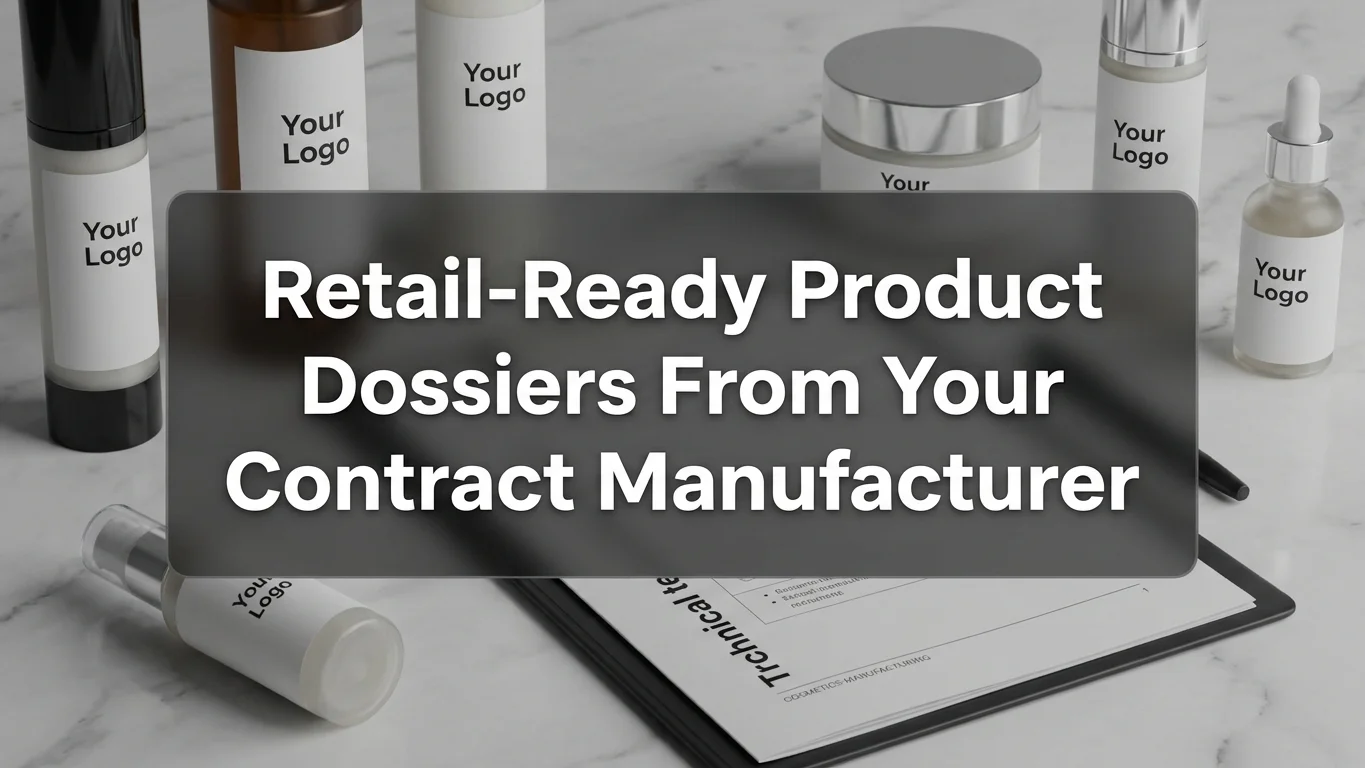
Getting your beauty brand onto the shelves of Sephora, Taikinys, or Ulta requires far more than a great formula and attractive packaging. Retail buyers at these chains demand rigorous technical documentation before they even consider a product line — and the right kosmetikos gamintoja is your single most important partner in building that documentation package. Without a professionally assembled product dossier, your pitch meeting is over before it begins.
Here’s what most indie brand founders don’t realize: the technical files, compliance certificates, and sell sheets that get products into major retail aren’t created after the product is finished. They’re built metu formulation and manufacturing, embedded into every stage of the process. Your manufacturer either generates this documentation as a standard part of production — or you’re left scrambling to reverse-engineer it at enormous cost and delay.
This guide walks you through every document retail buyers expect to see in 2026, explains why each one matters, and shows how an experienced manufacturing partner produces them as an integrated part of bringing your product to market. Whether you’re preparing for your first retail pitch or expanding into new chains, understanding the retail dossier process will materially improve your placement odds.
aš. What a Retail Buyer-Ready Product Dossier Actually Contains
A product dossier is the comprehensive technical and commercial file that accompanies your product when presented to a retail buyer. Think of it as the “résumé” for your SKU — it tells the buyer everything they need to verify that your product is safe, atitinkantis, efektyvus, commercially viable, and aligned with their merchandising standards.
A. Core Technical Documents
Every major U.S. retailer expects a baseline set of technical files. While the exact requirements vary by chain, the overlap is significant. The following documents form the foundation of virtually every retail dossier:
- Full INCI (Tarptautinė kosmetikos ingredientų nomenklatūra) breakdown — A complete, standardized ingredient list formatted per the Personal Care Products Council (PCPC) naming conventions
- Stability test data summary — Results from accelerated and real-time stability studies, typically covering 12 weeks minimum at multiple temperature and humidity conditions
- Mikrobiologinio poveikio testas (preservative efficacy test) sertifikatas — Proof that the formulation resists contamination from bacteria, mielės, and mold over the product’s intended shelf life
- Heavy metals Certificate of Analysis (COA) — Independent lab verification of lead, arseno, kadmis, and mercury levels below FDA and California Proposition 65 slenksčiai
- Clinical efficacy reports — Third-party or in-house studies supporting marketing claims (pvz., “reduces the appearance of fine lines by 27% į 4 savaites”)
- Gera gamybos praktika (GMP) sertifikavimas – ISO 22716 or GMPC documentation proving the facility meets international cosmetics manufacturing standards
B. Commercial and Compliance Documents
Beyond technical files, buyers require commercial documentation that demonstrates your brand is ready for the operational realities of retail distribution:
- Product sell sheets — One-page summaries with hero imagery, pagrindinių pretenzijų, kainodaros struktūra, minimum order details, and unique selling propositions
- Sustainability and ethical sourcing declarations — Increasingly required by Sephora (Clean at Sephora program), Taikinys („Target Clean“.), and Ulta, these cover ingredient sourcing, packaging recyclability, cruelty-free certifications, and carbon footprint data
- FDA registration documentation — Proof that the manufacturing facility is registered with the U.S. Food and Drug Administration’s Voluntary Cosmetic Registration Program (VCRP), now transitioning to mandatory registration under the Kosmetikos reguliavimo įstatymo modernizavimas (Mocra)
- Social compliance audit reports — Sedex/SMETA or similar audit certificates verifying ethical labor practices and environmental responsibility
Ausmetikos privalumas: Su 28+ metų kosmetikos gamybos sutartinės gamybos patirtis, Ausmetika palaiko ISO 22716, GMPC, and FDA registration as standard credentials — not add-ons. Every production run generates the stability data, COA, and challenge test certificates that retail buyers require, because these quality checkpoints are built directly into Ausmetics’ manufacturing workflow. Brands working with Ausmetics receive dossier-ready documentation without needing to commission separate third-party testing after the fact.
II. Why Retail Buyers Reject Brands — and How Documentation Prevents It
Understanding why brands fail to secure retail placement is just as important as knowing what to include. The most common rejection reasons are almost entirely preventable with proper documentation.
A. The Top Five Documentation Gaps That Kill Retail Deals
| Documentation Gap | Why Buyers Care | Consequence of Missing It |
|---|---|---|
| No stability data or incomplete testing protocol | Products that degrade on shelf create returns, klientų skundų, and liability | Immediate disqualification from consideration |
| Missing or outdated GMP certification | Retailers face regulatory exposure if products are made in non-compliant facilities | Brand flagged as “not retail-ready” |
| Unsubstantiated marketing claims | The FTC and NAD actively pursue misleading cosmetics advertising; retailers don’t want the risk | Buyer requests claim substantiation, delaying placement by 3–6 months |
| No heavy metals COA or outdated batch testing | California Prop 65 litigation risk; consumer safety obligations under MoCRA | Product cannot be sold in California — a market no national retailer will ignore |
| Absent sustainability or clean beauty declarations | Sephora, Taikinys, and Ulta all maintain clean beauty programs with specific ingredient exclusion lists | Product excluded from high-visibility “švarus” endcaps and promotional features |
B. What Buyers Actually Review First
Former retail buyers consistently report that they look at three things within the first 60 seconds of reviewing a brand submission: the sell sheet (for commercial viability), the GMP certification (for manufacturing credibility), and the stability summary (for shelf-life assurance). Everything else follows only if these three pass muster.
This means your kokybės užtikrinimas documentation isn’t supplementary — it’s the gateway. A visually stunning brand with incomplete technical files loses to a less glamorous brand with airtight documentation every time.
III. How an Experienced Cosmetics Contract Manufacturer Builds Each Document
The following section breaks down how a qualified manufacturing partner produces each critical document during the normal course of product development and production. This isn’t a separate service — it’s what professional-grade manufacturing looks like.
A. Stability Testing Protocols and Data Summaries
Stability testing begins during the formulation phase and continues through production. A properly equipped manufacturer conducts both accelerated stability studies (paprastai 12 weeks at 40°C/75% relative humidity) ir real-time stability monitoring (12–36 months at ambient conditions). The resulting data summary includes pH drift, viscosity changes, color shifts, fragrance retention, and microbial counts at each time point.
For retail submissions, you need a clean, professionally formatted summary — not raw lab printouts. Your manufacturer should produce a document that any buyer can scan in under two minutes, with pass/fail conclusions clearly stated for each parameter.
Veiksminga rekomendacija: When evaluating potential manufacturers, ask to see a sample stability data summary from a previous project (with proprietary details redacted). If they can’t produce one, they likely don’t generate them as standard practice.
B. Clinical Efficacy Reports and Claim Substantiation
Rinkodaros teiginiai kaip “visibly firms skin in 14 dienų” arba “93% of participants reported improved hydration” require documented evidence. Pagal Federal Trade Commission’s advertising guidelines, cosmetics claims must be truthful, not misleading, and supported by competent and reliable scientific evidence.
An patyręs kosmetikos kontraktinis gamintojas with in-house R&D capabilities can design and execute consumer perception studies, instrumental efficacy testing (using devices like Corneometer, Cutometer, or VISIA complexion analysis), ir suderinamumo testavimas. The resulting reports serve dual purposes: they substantiate your label claims ir they give retail buyers confidence that your product delivers on its promises.
C. Challenge Testing and Microbiological Certificates
The preservative efficacy test (PET), commonly known as the challenge test, yra nediskutuotinas. This test inoculates your formula with specific strains of bacteria (Staphylococcus aureus, Pseudomonas aeruginosa, Escherichia coli), mielės (Candida albicans), ir pelėsis (Aspergillus brasiliensis) to verify that your preservative system can suppress microbial growth over 28 dienų.
Manufacturers with on-site microbiology labs complete this testing as part of routine quality control. The resulting certificate — showing log-reduction values at each time interval — is a document every retailer’s quality team will request.
D. Heavy Metals COAs and Raw Material Traceability
Heavy metals testing is performed on both incoming raw materials and finished products. A Certificate of Analysis from an accredited independent laboratory (ISO 17025 sertifikuota) documents the levels of lead, arseno, kadmis, gyvsidabrio, and sometimes nickel against established thresholds. For products sold in the U.S., Kalifornijos pasiūlymas 65 establishes some of the strictest limits globally.
Kritiškai, COAs must be batch-specific. A COA from a different production batch is worthless to a retail buyer. Your manufacturer should generate fresh COAs for every production lot automatically.
IV. Building the Sell Sheet and Commercial Presentation Package
While technical files prove your product is safe and compliant, į sell sheet is what makes the buyer want to stock it. This one-page commercial document bridges the gap between laboratory data and retail merchandising.
A. Anatomy of an Effective Retail Sell Sheet
A sell sheet that performs well with buyers at Sephora, Taikinys, and Ulta typically contains the following elements on a single, visually polished page:
- Hero product image — Professional photography on white or lifestyle background
- Product name and SKU identifier
- Two to three key marketing claims — Each backed by the efficacy data in your dossier
- INCI ingredient list — Highlighted hero ingredients with brief benefit callouts
- Retail price point and suggested margin structure
- Pack size, case pack configuration, and UPC/EAN barcode
- Certifications and clean beauty program eligibility — Cruelty-free, veganas, „Target Clean“., Clean at Sephora badges as applicable
- Brand story snapshot — Two to three sentences on brand origin and target consumer
B. How Your Manufacturer Supports Sell Sheet Development
Jūsų OEM ir ODM gamybos partneris provides the raw technical content that populates your sell sheet: the verified claims, the accurate INCI list, the certifications, and the compliance badges. Some manufacturers go further by providing product photography-ready samples with final packaging, formatted technical summaries designed for buyer presentations, and ingredient storytelling content based on R&D ekspertizė.
The distinction between a manufacturer that hands you a formula and one that hands you a market-ready launch package is often the difference between a retailer saying “come back when you’re ready” ir “let’s discuss placement.”
V. The 2026 Compliance Landscape and What Retailers Now Require
The regulatory environment for cosmetics sold in the United States shifted significantly with MoCRA’s implementation. Nuo 2026, cosmetics manufacturers must comply with facility registration requirements, adverse event reporting obligations, and forthcoming Good Manufacturing Practice regulations being finalized by the FDA. These changes have raised the documentation bar for retail placement.
A. MoCRA’s Impact on Retail Dossiers
Pagal MoCRA, cosmetics facilities must register with the FDA, products must be listed, and serious adverse events must be reported within 15 darbo dienos. Prekės ženklo įkūrėjams, this means your dossier now needs to include proof of objekto registracija, product listing confirmation, and evidence of an adverse event reporting system.
Retailers have responded by tightening their vendor qualification processes. Sephora and Target, pavyzdžiui, now routinely request MoCRA compliance documentation as part of their standard onboarding packets. Brands that cannot provide these documents are increasingly filtered out during initial screening.
B. Sustainability Documentation as a Competitive Advantage
Environmental and social governance (ESG) documentation has evolved from “malonu turėti” to a genuine competitive differentiator. Į 2026, Sephora’s Clean + Planeta teigiama programa, Target’s Target Zero initiative, and Ulta’s Conscious Beauty platform all require specific sustainability declarations covering:
- Packaging recyclability percentages and post-consumer recycled (PGR) turinį
- Ingredient sourcing certifications (RSPO for palm-derived ingredients, fair trade certifications)
- Manufacturing facility environmental practices (energy usage, vandens apdorojimas, atliekų nukreipimo normos)
- Social compliance audits (Sedex/vargo, BSCI, arba lygiavertis)
Ausmetikos privalumas: As a Sedex-audited, FDA-registered facility with ISO 22716 ir GMPC sertifikatai, Ausmetics — founded in 1998 su per 28 years of manufacturing expertise — provides the full spectrum of compliance and sustainability documentation that 2026 retail buyers demand. Įmonės R&D komanda, vadovaujama dr. Jadiras Nunesas (buvęs IFSCC pasaulinis prezidentas ir buvęs Johnsonas & Johnsonas), ensures that formulation decisions are made with regulatory foresight, so brands don’t discover compliance gaps at the worst possible moment — during a buyer meeting. Ausmetics currently manufactures for 600+ pasauliniai grožio prekių ženklai, many of which are stocked in major international retail chains.
VI. Building Your Retail Submission Timeline
One of the most frequent mistakes brand founders make is underestimating how long dossier preparation takes. Retail buyers at major chains typically review submissions on seasonal cycles, and missing a window can delay your launch by six months or more.
A. Recommended Timeline for Retail-Ready Documentation
| Fazė | Laiko juosta | Key Deliverables |
|---|---|---|
| Formulation and preliminary stability testing | Months 1–3 | Prototype formula, accelerated stability study initiated, preliminary INCI list |
| Challenge testing and efficacy studies | Months 2–4 | PET certificate, consumer panel results, instrumental data |
| Production samples and final COAs | Months 4–5 | Batch-specific heavy metals COA, final stability data summary, production-grade samples |
| Sell sheet and dossier assembly | Mėnuo 5 | Formatted sell sheet, complete technical file, compliance package, sustainability declarations |
| Retail buyer submission | Mėnuo 6 | Full dossier submitted per retailer-specific guidelines |
B. Why Starting with the Right Manufacturer Compresses This Timeline
When your manufacturer generates documentation as an integrated part of production — rather than as an afterthought — the dossier assembly phase shrinks from weeks to days. Every test result, every certificate, and every compliance document already exists in a format that’s ready for buyer review. This is the practical advantage of working with a patikimas kosmetikos gamybos sutarties partneris: you don’t waste months chasing paperwork that should have been created during production.
Veiksminga rekomendacija: Prieš pasirašydami su bet kuriuo gamintoju, request a sample dossier package. Ask specifically for examples of their stability summary format, COA templates, and challenge test certificates. If the documents look professional and buyer-ready, you’ve found a partner who understands retail requirements. If they look like internal lab notes, keep searching.
Dažnai užduodami klausimai
What documents do Sephora, Taikinys, and Ulta require in a product submission dossier?
While each retailer has slightly different submission requirements, all three expect a core set of technical and commercial documents. These include a full INCI ingredient list, stability test data (both accelerated and real-time), microbiological challenge test certificates, heavy metals Certificates of Analysis, GMP and facility registration proof, clinical efficacy data supporting marketing claims, and sustainability or clean beauty program declarations. Papildomai, į 2026, MoCRA compliance documentation — including FDA facility registration and product listing confirmation — has become a standard requirement across all major U.S. mažmenininkai. A professionally formatted sell sheet with commercial details rounds out the submission.
How long does it take to prepare a retail buyer-ready product dossier?
From the start of formulation to a complete, submission-ready dossier, the typical timeline is five to six months. Accelerated stability testing alone requires a minimum of 12 savaites, and challenge testing adds another four weeks. Clinical efficacy studies can run concurrently but typically need six to eight weeks for meaningful results. Working with a manufacturer that generates documentation as part of its standard production process — rather than requiring separate third-party commissioning — can compress the overall timeline by several weeks, particularly during the final dossier assembly phase.
Can my cosmetics contract manufacturer help with sell sheet design and content?
A capable manufacturer provides the technical content foundation for your sell sheet: verified and substantiated marketing claims, accurate INCI lists, certification badges, and efficacy data points. Some manufacturers with full-service private label capabilities also assist with packaging design, product photography coordination, and commercial positioning guidance. Tačiau, the final graphic design and brand storytelling elements are typically handled by your creative team or a branding agency, using the technical content your manufacturer supplies.
What happens if my product dossier is incomplete when I submit to a retailer?
An incomplete dossier typically results in one of two outcomes: outright rejection or a request to resubmit — which often means waiting for the next review cycle, potentially six months away. Retail buyers evaluate hundreds of brand submissions per season, and incomplete packages signal that a brand isn’t operationally ready for the demands of retail distribution. Kai kuriais atvejais, a buyer may offer feedback on what’s missing, but this is not guaranteed. The safest approach is to treat your dossier as a one-shot opportunity and ensure every required document is included, srovė, and professionally formatted before submission.
Why is MoCRA compliance documentation now required for retail placement?
Kosmetikos gaminių reguliavimo modernizavimo įstatymas, gruodžio mėnesį pasirašė įstatymą 2022 and with provisions rolling into enforcement through 2026, established the first major overhaul of U.S. kosmetikos reglamentas nuo 1938. MoCRA introduced mandatory facility registration, produktų sąrašas, pranešimų apie nepageidaujamus reiškinius, and forthcoming GMP requirements. Retailers face potential liability if they stock products from non-compliant brands or facilities, so they now include MoCRA documentation in their standard vendor qualification process. This includes proof of FDA facility registration, product listing numbers, and evidence that the brand has an adverse event reporting system in place.
Išvada ir tolesni žingsniai
Securing shelf space at Sephora, Taikinys, Ulta, or any major retailer is fundamentally a documentation exercise as much as it is a branding one. The brands that win placements aren’t always the ones with the flashiest packaging — they’re the ones that arrive at buyer meetings with airtight technical files, substantiated claims, current compliance certificates, and professionally polished sell sheets.
Your manufacturing partner plays the central role in generating this documentation. An patyręs kosmetikos kontraktinis gamintojas su ISO 22716 sertifikavimas, FDA registracija, R&D gylis, and a proven track record with retail-distributed brands doesn’t just make your product — they make your product credible in the eyes of the buyers who control access to millions of consumers.
If you’re preparing for retail expansion in 2026 and want a manufacturing partner that produces complete, buyer-ready documentation as standard practice, kreiptis į Ausmetikos komandą to discuss your project requirements and timeline. Su 28+ years of manufacturing expertise and partnerships with over 600 pasauliniai grožio prekių ženklai, Ausmetics provides the technical foundation that turns retail ambitions into confirmed purchase orders.