Few formulation decisions shape a sun care line as much as the choice between a private label mineral sunscreen and a chemical one. Ar mineral vs chemical sunscreen question affects how the product feels, how it photographs on skin, which markets you can sell into, and how complex the formula is to produce at scale. For any brand briefing a manufacturer for private label sunscreen manufacturing, getting this right early saves expensive reformulation later.
One thing to settle before any formula decision: a sunscreen's regulatory class is set at the national or trade-bloc level, not by continent, and it differs from market to market. Most of the world regulates sunscreen as a cosmetic — under the EU's Nthäki (EC) 1223/2009 or frameworks modeled on it — while a handful of markets treat it as a drug or therapeutic good. This guide is written for cosmetic-regulated markets; always confirm the rules for your specific target market.
What follows is a practical comparison for brand owners: how the two filter families actually work, the formulation trade-offs that decide the finished product, how your target market dictates which filters you can use, how to match a formula to your buyer, and the testing and compliance steps that have to happen before launch.
Nuga̲. What "Mineral" y "Chemical" Sunscreen Actually Mean
Every sunscreen protects skin with UV filters, and those filters fall into two families. Mineral filters — also called physical or inorganic filters — are zinc oxide y titanium dioxide. Chemical filters, more accurately called organic filters, include ingredients such as avobenzone, octinoxate, octocrylene, homosalate, octisalate, and newer broad-spectrum molecules like bemotrizinol and bisoctrizole.
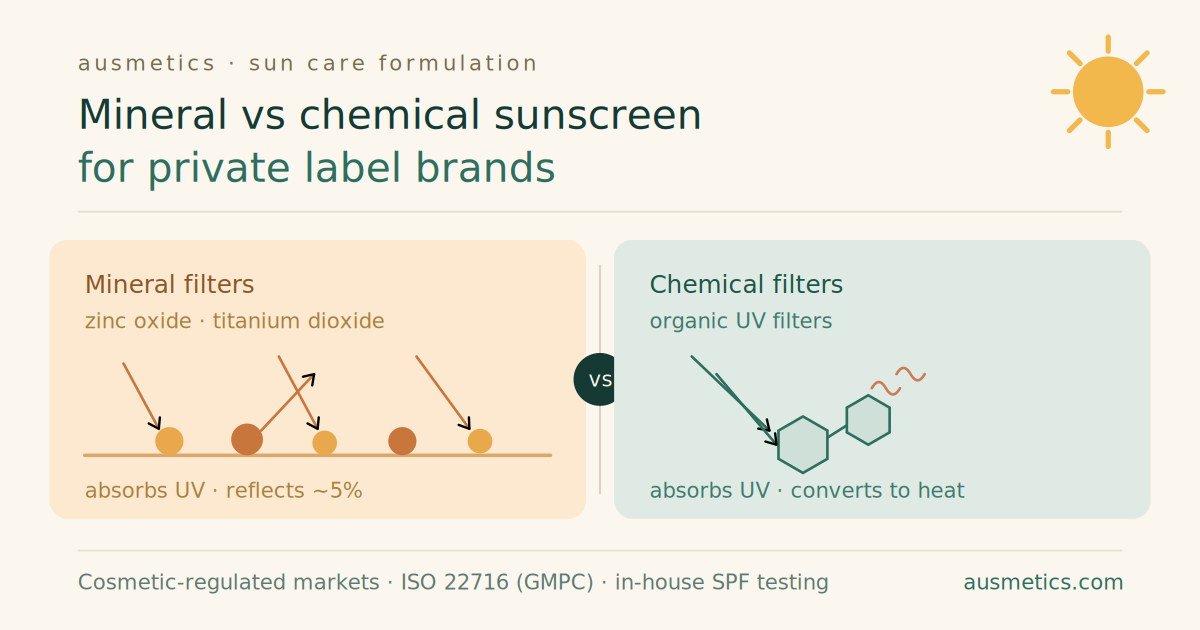
Marketing often says mineral filters "reflect" UV like a mirror while chemical filters "absorb" it. The science is less tidy. Peer-reviewed measurements show that zinc oxide and titanium dioxide reflect only about 4–5% of incident UV across the spectrum and protect mainly by absorbing it, the same way organic filters do, and a 2025 analysis of mineral products on the market reached the same conclusion. In practice both families work primarily by absorbing UV radiation; the meaningful differences are in feel, stability, gentleness, finish, and regulatory treatment, not the basic mechanism.
Within the mineral family, the two filters are not interchangeable. Zinc oxide is the only single mineral filter that covers the full UVB-through-long-UVA range on its own, which is why it anchors most broad-spectrum mineral formulas. Titanium dioxide is strong against UVB and short UVA but weak against long UVA, so formulators usually pair it with zinc rather than relying on it alone. Pairing also lets a formula run a lower total mineral load, which reduces white cast.
II. Formulation Trade-Offs That Shape the Final Product
At the production level, the choice between the two families is really a choice between two very different formulation problems.
'Nar. Formulating mineral sunscreens
Mineral actives are insoluble powders, so the central challenge is dispersion: zinc oxide and titanium dioxide particles must be distributed evenly and kept from clumping, because agglomeration creates gaps in the protective film and uneven SPF. Surface-coated particles, the right emulsifier system, and careful processing all matter. Mineral formulas tend to be thicker and can feel heavier, and they carry the well-known white cast, most visible with non-nano particles and on deeper skin tones. Nano-scale particles reduce that cast; in the EU, any nanomaterial filter must be labelled with "[nano]" beside its name. The upside is real: both minerals are highly photostable, Hogu̲jä'i, and well suited to sensitive-skin, le̲le̲, and post-procedure products.
B. Formulating chemical sunscreens
Organic filters bring the opposite profile. They dissolve into the oil or water phase, which makes lightweight textures, sprays, and clear gels far easier to achieve, and they reach high SPF values more efficiently. The catch is photostability: some filters, notably avobenzone, degrade in sunlight unless stabilized, typically by pairing them with octocrylene or with a photostable broad-spectrum filter such as bemotrizinol. A well-built chemical formula is a balancing act of filter combinations, solubilizers, and stabilizers. Some older organic filters also carry consumer concerns around skin sensitivity, systemic absorption, or coral reefs, which shapes how a brand positions them.
C. The hybrid middle ground
Many modern sunscreens are neither purely mineral nor purely chemical. Hybrid formulas combine a mineral filter with organic ones, or with UV boosters, to balance the gentleness and photostability of zinc against the lighter finish of organics, often allowing a lower mineral load and less white cast. For a brand that wants mineral positioning without a heavy feel, a hybrid is frequently the most commercial answer.
| Attribute | Mineral (zinc oxide / titanium dioxide) | Chemical (organic filters) |
|---|---|---|
| Primary mechanism | Mainly absorbs UV; reflects only ~4–5% | Absorbs UV, converts it to heat |
| Broad-spectrum on its own | Hä, with zinc oxide | Depends on filter; often needs combinations |
| Texture and finish | Thicker; possible white cast | Lightweight; usually invisible |
| Photostability | High | Varies; avobenzone needs stabilizing |
| Sensible / baby skin | Generally well tolerated | More likely to sting or irritate |
| Ease of high SPF | Harder without heavy loading | Easier and more elegant |
| Best formats | Creams, Palos, tinted products | Fluids, sprays, clear gels, high-SPF |
| Typical positioning | Clean, sensitive, le̲le̲, reef-conscious | Daily wear, sport, cosmetically elegant |
Ausmetics Advantage: Even mineral dispersion and reliable chemical photostability are exactly what separates a comfortable, evenly protecting sunscreen from a chalky or under-performing one. Ko nä'ä ar 28 years of OEM/ODM formulation experience and in-house labs, Ausmetics develops mineral, chemical, and hybrid OEM sunscreen formulation for brands selling into cosmetic-regulated markets.
III. Your Market Decides Which Filters You Can Use
Which filters you can legally use depends on how your target market regulates sunscreen, and cosmetic-regulated markets generally offer a wider, more modern palette. The EU's Annex VI positive list permits well over two dozen UV filters — around 29 — compared with roughly 16 in the US drug monograph. That gap includes advanced broad-spectrum filters widely used in cosmetic markets, ngu bemotrizinol (Tinosorb S), bisoctrizole (Tinosorb M), and the Mexoryl filters, several of which are more photostable than avobenzone. For chemical and hybrid formulas in particular, this means brands in cosmetic markets can build elegant, photostable broad-spectrum products that brands in some drug-regulated markets cannot.
Mineral filters cut the other way. Zinc oxide and titanium dioxide are accepted almost everywhere, including as the two actives that regulators in stricter markets treat most favorably. A well-made mineral formula is therefore the most portable across markets, which helps if you plan to register one product in several regions or to enter markets with tighter rules on organic filters.
Filter choice can even decide the regulatory route. In Canada, a sunscreen using only mineral filters can qualify as a natural health product, while one using organic filters is handled as a non-prescription drug. Geography is often the result of a formulation decision, not just a constraint on it.
In the EU, a product can claim broad-spectrum protection only if its UVA protection is at least one-third of its SPF and its critical wavelength reaches at least 370 nm. And because the United States (an OTC drug) and Australia (a therapeutic good under the TGA) require pharmaceutical-grade drug manufacturing, sunscreen for those two markets sits outside cosmetic contract manufacturing entirely.
| Market | How sunscreen is regulated |
|---|---|
| Mfats'i Europea | Cosmetic — Regulation (EC) 1223/2009 |
| Ndä mfats'i | Cosmetic — UK Cosmetics Regulation |
| Southeast Asia (ASEAN) | Cosmetic — ASEAN Cosmetic Directive |
| Nu Brasil | Registered "Grade 2" cosmetic (ANVISA) |
| Gulf states (GCC) | Cosmetic — GCC / GSO standards |
| Ir 'rangu̲di | OTC drug (FDA monograph) |
| Canadá | Non-prescription drug or natural health product |
| Australia | Therapeutic good (TGA) |
| Japón | Quasi-drug |
| Corea ar Sur | Functional cosmetic |
IV. Matching the Formula to Your Brand and Buyer
With the science and the rules in view, the practical question is which formula fits your buyer, your positioning, and your format.
'Nar. Skin type and the buyer
For sensitive, reactive, acne-prone, le̲le̲, or post-procedure skin, mineral wins on tolerability — zinc oxide is gentle and soothing, and mineral formulas are less likely to sting the eyes or trigger irritation. For everyday wear, sport, and buyers who simply will not accept any residue, chemical or hybrid formulas deliver a lighter, more invisible finish.
B. Skin tone and finish
White cast is not a minor cosmetic detail; it disproportionately affects deeper skin tones and is a leading reason consumers abandon mineral sunscreen. Brands serving a wide range of skin tones often choose a chemical or hybrid base, or a tinted mineral formula that uses iron oxides to neutralize the cast while adding visible-light protection. Matching finish to your actual customer base is a commercial decision as much as a formulation one.
C. Positioning, Njots'i hmä, and format
Positioning usually points one way or the other. Clean, sensitive-skin, le̲le̲, and reef-conscious lines lean mineral; rendimiento, high-SPF, sport, and makeup-friendly daily lines lean chemical or hybrid. One caution on claims: terms like "reef-safe" are marketing language, not legally defined standards, so phrase environmental claims carefully and check your target market's rules. Format matters too — sticks, balms, thick creams, and tinted products suit mineral filters, while sprays, clear gels, fluids, and lightweight high-SPF products are far easier to build with organic filters.
| If your priority is… | Lean toward… |
|---|---|
| Gentleness for sensitive, le̲le̲, or post-procedure skin | Mineral |
| An invisible finish across all skin tones | Chemical or hybrid (or tinted mineral) |
| A clean / reef-conscious positioning | Mineral or mineral-led hybrid |
| High SPF with a lightweight feel | Chemical or hybrid |
| Rociar, mist, or clear-gel format | Chemical |
| One formula registrable across many markets | Mineral or modern-filter hybrid |
Ausmetics Advantage: Because the right answer is so often "it depends," working with a manufacturer that formulates across all three approaches matters. Ausmetics develops mineral, chemical, hybrid, and tinted sunscreens in multiple formats — creams, fluids, Palos, and sprays — for Hñeti ar piel marca kadu̲ 'nar jä'i and sun care brands in cosmetic-regulated markets.
V. Testing, Claims, and Compliance Before You Launch
Whichever route you choose, the product has to be tested and documented before it can carry its claims.
'Nar. SPF and UVA are tested separately
SPF and UVA protection are two different endpoints, measured by different ISO methods — a distinction worth getting right. The sun protection factor is determined in vivo under ISO 24444, the MED-based reference method; an in-vitro double-plate method, ISO 23675:2024, has also been published. UVA protection is assessed separately: in vivo through ISO 24442, the persistent-pigment-darkening method that underpins Japan's PA grading, or in vitro through ISO 24443, which yields the UVA-PF and critical-wavelength values the EU uses for labelling. A newer hybrid method, ISO 23698:2024 diffuse-reflectance spectroscopy, captures SPF, UVA-PF, and critical wavelength in a single workflow.
B. Claims, stability, and the regulatory dossier
Water-resistance claims require their own testing, and every formula needs stability and preservation data and a defined period-after-opening. For cosmetic markets, the compliance file typically includes a safety assessment by a qualified person and a Product Information File; in the EU these accompany notification on the CPNP portal, ASEAN markets use their own notification systems, and Brazil requires ANVISA registration. Keeping SPF and broad-spectrum claims fully substantiated, and avoiding drug-style claims in cosmetic markets, keeps a launch on the right side of the rules.
C. What to look for in a manufacturer
For sunscreen specifically, the credentials that matter are cosmetic GMP and genuine in-house testing capability, not a company-wide certificate that says little about sun care itself. Look for ISO 22716 (GMPC) manufacturing and in-house SPF testing, which let a partner refine a formula and verify performance during development rather than only at the end.
Ausmetics Advantage: Ausmetics manufactures under ISO 22716 (GMPC) with in-house SPF testing and an R&D team led by Dr. Jadir Nunes, former global president of the IFSCC. For brands in cosmetic-regulated markets, that combination supports both compliant documentation and the formulation iteration a strong sunscreen needs. You can review our garantía ar hño standards for the full picture.
Ya nt'a̲ni frecuentes
Is a mineral sunscreen better than a chemical one?
Neither is inherently better; the right choice depends on your buyer, your positioning, and your target market. Both families protect mainly by absorbing UV. Mineral formulas are gentler, more photostable, and more portable across markets, which suits sensitive-skin, le̲le̲, and clean lines. Chemical and hybrid formulas are lighter, more invisible across skin tones, and reach high SPF more easily, which suits daily-wear and performance lines.
Why do mineral sunscreens leave a white cast, and can it be removed?
The cast comes from zinc oxide and titanium dioxide scattering visible light, and it is most noticeable with non-nano particles and on deeper skin tones. A manufacturer can reduce it with nano-scale, well-dispersed particles, by pairing the two minerals to lower the total load, or with a tinted formula that uses iron oxides. It can be minimized substantially, though rarely eliminated entirely in a pure mineral product.
Can I make a "reef-safe" protector solar?
You can formulate a sunscreen free of the organic filters most often raised in reef discussions, such as oxybenzone and octinoxate, and many brands use mineral or mineral-led formulas for this positioning. Keep in mind that "reef-safe" is a marketing term with no single legal definition, so claims should be worded carefully and checked against the rules and any specific ingredient bans in your target market.
Which type makes a high-SPF product easier to manufacture?
Chemical and hybrid formulas generally reach high SPF more efficiently and with a lighter feel, because organic filters dissolve into the formula and combine well. A pure mineral product can also reach high SPF, but usually needs higher zinc oxide and titanium dioxide loading, which can mean a thicker texture and more white cast. UV boosters can help a mineral formula perform above its filter level.
Do mineral sunscreens work instantly while chemical ones need time?
Chemical sunscreens are conventionally applied about 15 Pa 20 minutes before sun exposure, while mineral filters are effective as soon as the film is in place. In real-world use, though, applying enough product and reapplying regularly matters far more than the filter type for either family. Ar "works instantly" advantage of mineral is real but modest, and should not be oversold to consumers.
Conclusion and Next Steps
There is no universal winner in the mineral vs chemical sunscreen decision. Mineral formulas offer gentleness, photostability, and the widest market portability; chemical and hybrid formulas offer lighter textures, an invisible finish across skin tones, and easier high SPF. Modern filters give brands in cosmetic-regulated markets more room than ever to build elegant broad-spectrum products. The right choice follows from your buyer, your positioning, your format, and the rules of your target market, validated with proper SPF and UVA testing.
If you are weighing a private label mineral sunscreen against a chemical or hybrid formula, the most useful next step is to brief a manufacturer that builds all three. Ausmetics develops compliant sun care for cosmetic-regulated markets, backed by 28+ years of OEM/ODM experience, ISO 22716 (GMPC) producción, and in-house SPF testing. Explore our private label sunscreen development capabilities, o contact our team to discuss your formula, target market, and SPF goals.