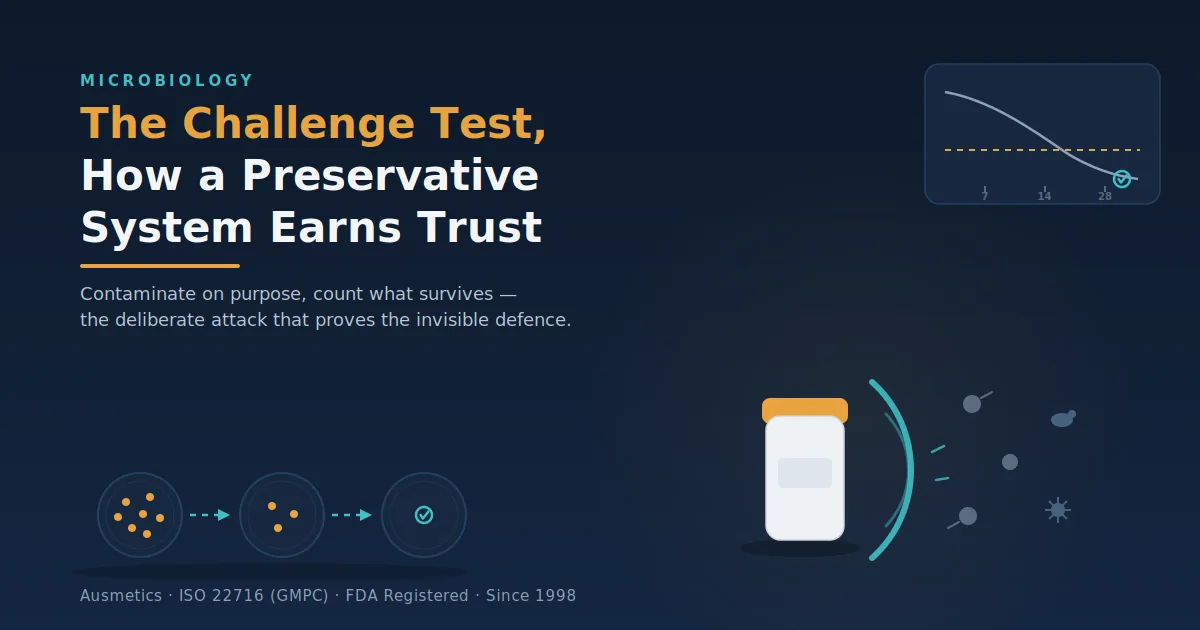
Test prowokacyjny – formalnie, badanie skuteczności konserwantów — celowo zaszczepia produkt kosmetyczny mikroorganizmami, a następnie zlicza je w czasie, aby udowodnić, że system konserwujący może powstrzymać to, co nieuchronnie wprowadzi codzienne użytkowanie. Z trzech stabilności, jakie musi posiadać produkt, to jest ten cichy. Rozszczepiony krem zapowiada się już na pierwszy rzut oka; osłabienie systemu konserwującego nic nie mówi — aż do momentu, w którym ma to największe znaczenie.
W naszym przewodniku po stabilności stabilność mikrobiologiczna to temat zasługujący na osobny artykuł. To jest ten artykuł. A jego główna idea należy do samego standardu: ISO 11930, międzynarodowa metoda oceny ochrony antybakteryjnej kosmetyków, określa tę ochronę jako pochodzącą ze źródeł obejmujących konserwację chemiczną, nieodłącznych cech preparatu, projekt opakowania, i proces produkcyjny. Innymi słowy: system konserwujący to system, nie składnik. Test wyzwań polega na tym, że cały system, ani jednej cząsteczki, zdobywa jego zaufanie.
W tym przewodniku opisano dowód po stronie fabryki – strony, której laboratorium przeprowadzające badania drobnoustrojów prowadzi te badania: dlaczego celowo symuluje się zanieczyszczenie, jak test faktycznie działa, dlaczego listy składników oferowane przez sprzedawców detalicznych zamieniły konserwację w dziedzinę inżynierii, i jak kupujący powinien przeczytać otrzymany raport.
I. Po co zanieczyszczać celowo
Ponieważ klient to zrobi. Słoik zostaje otwarty i do środka wchodzi palec; woda z prysznica rozpryskuje się w butelce; a pump sits warm and damp on a bathroom shelf for a year. The PAO figure on an EU label — how long a product stays safe after first opening — is, at heart, a microbiological promise: opening introduces contamination, and the preservative system has to keep handling it for months of real life. The challenge test simulates that future in advance, under control, where a failure costs a reformulation instead of a recall.
The stakes justify the method. Physical failures are visible and chemical failures are measurable, but microbial failures are invisible right up until they are harmful — which is why this is the one dimension of stability that is proven by deliberate attack. The product is contaminated on purpose, and the system is watched while it fights.
II. Jak faktycznie przebiega test
Pod spodem mikrobiologia, struktura jest prosta — kontrolowana walka z tablicą wyników:
| Krok | Co się stanie | Co ci to mówi |
|---|---|---|
| Kontrola linii bazowej | Początkowa jakość mikrobiologiczna produktu jest potwierdzana przed dodaniem czegokolwiek | Test zmierzy wydajność systemu, a nie istniejące wcześniej zanieczyszczenie |
| Szczepienie ochronne | Próbki ładuje się za pomocą standardowego panelu pięciu organizmów — S. aureus, mi. coli, P. aeruginosa, C. albicany, i A. brasiliensis — w stężeniach określonych przez normę | Bakteria, drożdże, i foremka: realistyczne spektrum tego, co pozwala na użycie |
| Liczy się czas | Ocalałych liczy się w ustalonych odstępach czasu w ciągu mniej więcej miesiąca – zazwyczaj w dniach 7, 14, oraz 28, z wcześniejszymi punktami w niektórych schematach | Czy system szybko się zabija, trzyma się ziemi, albo po cichu to traci |
| Redukcja a kryteria | Zmierzone redukcje log są porównywane z opublikowanymi kryteriami akceptacji normy | Przechodzić, zaliczyć z udokumentowanym uzasadnieniem, lub z powrotem do stołu recepturowego |
W praktyce liczą się dwa udoskonalenia. Pierwszy, kryteria występują na dwóch poziomach: kryterium standardu A reprezentuje zalecany poziom skuteczności, natomiast kryterium B jest dopuszczalne, jeżeli uzasadnia to udokumentowana ocena ryzyka – tj "przeszedł" to nie jedno słowo, ale wybór powiązany z uzasadnieniem. Drugi, metoda ma rodzeństwo: akredytowane laboratoria przeprowadzić testy obciążeniowe w ramach ISO 11930, rozdział Farmakopei USA, lub Farmakopei Europejskiej, a schematy różnią się czasem pobierania próbek i kryteriami akceptacji, mimo że cel jest wspólny. Raport, który mówi "zdał test wyzwań" bez podania schematu i wersji nie dokończył zdania.
III. Inżynieria konserwatorska w dobie listy
Prawo wyznacza pierwszą granicę: rozporządzenie UE dotyczące kosmetyków zawiera listę pozytywną – w ogóle można stosować wyłącznie konserwanty wymienione w załączniku V. Następnie programy sprzedaży detalicznej, w których zmapowaliśmy listy substancji objętych ograniczeniami tnij głębiej: rodziny konserwantów, które pozostają legalne w określonych granicach — propyl- a wśród nich butyloparabeny – miały zostać usunięte w ramach polityki chemicznej sprzedawców detalicznych, czego nie wymagała żadna ustawa. Każde wykluczenie zawęża zestaw narzędzi, a skrzynka z narzędziami nigdy nie była duża.
Dlatego właśnie nowoczesna konserwacja to inżynieria, a nie selekcja, opierając się na każdym źródle ochrony, nazwy ramek standardu:
| Źródło ochrony | Jak to wygląda w praktyce |
|---|---|
| Konserwacja chemiczna | Mniejsze dawki wielu kompatybilnych substancji aktywnych działających synergicznie, zamiast jednej ciężkiej cząsteczki |
| Sam preparat | pH ustawione tam, gdzie walczą drobnoustroje, aktywność wody utrzymywana na niskim poziomie, składniki wybrane tak, aby głodzić wzrost, a nie go karmić |
| Projekt opakowania | Pompki bezpowietrzne i wąskie otwory, które wpuszczają do środka znacznie mniej świata, niż kiedykolwiek zrobi to otwarty słoik |
| Proces produkcyjny | Higiena, systemy wodne, i elementy sterujące, które zapewniają systemowi konserwującemu czystą linię startową |
Test sprawdzający polega na tym, że przebudowany system nadal działa. A "wolne od" Historia konserwacji, która nie przetrwała celowego zaszczepienia, jest twierdzeniem marketingowym; taki, który ma, jest plikiem bezpieczeństwa.
IV. Kalendarz, Granice, i Fabryka
W zdyscyplinowanym programie test wyzwań przebiega równolegle ze starzeniem się pracy, którą nakreśliliśmy badanie stabilności kosmetyków, i wiele protokołów powtarza to na starszych próbkach – ponieważ system konserwujący może osłabiać się w miarę starzenia się zawartej w nim receptury, a obietnica musi być dotrzymana do końca okresu przydatności do spożycia, nie tylko na początku. Granice wyznacza sam standard: metoda przeznaczona jest przede wszystkim do produktów zawierających wodę, oraz formaty, dla których ryzyko mikrobiologiczne zostało określone jako niskie – norma wskazuje to na ISO 29621 — może uzasadnić wyłączenie udokumentowaną oceną ryzyka. Zwolnienie to argument, który ktoś podpisuje, nie jest to skrót, który ktoś wybiera.
Zmiana dyscypliny zamyka pętlę: wymiana środka konserwującego to poważna zmiana poziomu na każdej poważnej mapie poziomów, a jego mostek równoważności obejmuje nowy test prowokacyjny – porównanie papieru nie może wykazać krzywej zabijania. w Ausmetics, prace te prowadzone są w specjalnym laboratorium zajmującym się badaniami mikrobiologicznymi, jedno z czterech wewnętrznych laboratoriów, wraz z rutynową kontrolą mikrobiologiczną Zapewnienie jakości system stosuje partię po partii. dla Producent kosmetyków OEM i ODM przebudowa systemów konserwacji w oparciu o coraz krótsze listy składników, posiadanie własnej pętli ataku i liczenia jest tym, co utrzymuje tę inżynierię w kalendarzu rozwoju.
V. Czytanie raportu z wyzwania jak kupujący
Z naszego doświadczenia wynika, że obsługujemy programy markowe i detaliczne, pięć pytań oddziela raport od pieczątki. Jaki schemat i wersja — ISO 11930, USP, EP — bo się różnią, oraz "przeszedł" jest bez znaczenia, bez nazwy. Które kryterium — A, lub B wraz z pisemnym uzasadnieniem, ponieważ pismo jest decyzją, nie stopień. Czy przeprowadzono pełny panel organizmu, plus wszelkie dodatki wymagane przez produkt. Które punkty czasowe zostały faktycznie pobrane, na jakiej wersji formuły, w jakim kontekście opakowania. Jaka jest polityka w przypadku niepowodzenia testu – pętla przeformułowania i ponowne przetestowanie dowodów, ponieważ historia konserwacji bez żadnych usterek jest zbiorem danych, nie jest to rekord osiągnięć.
Jednoliniowy "test wyzwań zaliczony" jest znaczek. Raport, który możesz przesłuchać, to system, który zyskuje przed tobą zaufanie.
Często Zadawane Pytania
Czy każdy produkt kosmetyczny wymaga testu prowokacyjnego??
Produkty zawierające wodę zazwyczaj tak robią – woda sprawia, że formuła nadaje się do zamieszkania. Formaty, w przypadku których ryzyko mikrobiologiczne jest naprawdę niskie — produkty bezwodne, bardzo wysoki poziom alkoholu, ekstremalne pH – może uzasadniać wyłączenie na podstawie udokumentowanej metody oceny ryzyka, do której odwołuje się sama norma. Słowo kluczowe jest udokumentowane: zwolnienie jest podpisanym argumentem w pliku bezpieczeństwa, a nie założenie przyjęte na ławce rezerwowych.
Jaka jest różnica między ISO 11930 oraz metody farmakopealne?
Cel jest wspólny; schematy nie. ISO 11930 a rozdziały farmakopei amerykańskiej i europejskiej wykorzystują nakładające się panele organizmów, ale różnią się czasem pobierania próbek i kryteriami akceptacji, więc formuła może spełniać jeden schemat i nie spełniać innego. Właśnie dlatego kupujący pytają o schemat i wersję z nazwy — i dlatego fabryki obsługujące kilka rynków mapują różnice, zamiast traktować je "test wyzwania" jako jedna rzecz.
Jeśli produkt przejdzie test prowokacyjny, czy jest chroniony na zawsze?
Nie — przepustka potwierdza, że system jest zgodny z założeniami, zapakowane, i wyprodukowane w tamtym czasie. Starzenie się może osłabić konserwację, nowe opakowanie zmienia ekspozycję, korekta formuły zmienia chemię, a zmiana procesu może zmienić początkowe obciążenie biologiczne. Dlatego zdyscyplinowane programy ponownie testują czynniki wyzwalające i łączą test prowokacyjny z rutynową kontrolą mikrobiologiczną każdej partii, więc sprawdzony system pozostaje systemem dostarczonym.
Czy zmiana konserwantu oznacza powtórzenie testu??
TAk. Zamiana środka konserwującego zmienia dokładnie funkcję, którą ten test ma udowodnić, dlatego mostek równoważności obejmuje nowy test obciążeniowy wraz z mostkowaniem stabilności — samo porównanie specyfikacji nie może wykazać krzywej zabijania. W języku map poziomów jest to poważna zmiana: akceptacja klienta przed realizacją, dowód przed wysyłką, oraz pierwsze partie w ramach nowego systemu zidentyfikowane jako takie.
Wnioski i dalsze kroki
Test prowokacyjny jest cichym odpowiednikiem każdej widocznej obietnicy na etykiecie: celowy atak, który dowodzi niewidzialnej obrony. Jego logika jest spójna ze standardem — ochrona wynika z chemii, sformułowanie, paczka, i cały proces – w czasach, gdy lista sprzedawców detalicznych stale się kurczy, a zestaw narzędzi chemicznych jest coraz mniejszy, test polega na tym, że przeprojektowane systemy wykazują, że nadal się sprawdzają. Zaufanie tutaj nie jest wymagane; jest zaszczepiony, liczone, i zarobił.
Ausmetics sprawdzał ten dowód przez 28+ lat od ISO 22716 (GMPC) atestowany, Obiekty poddane audytowi Sedex w Kantonie — dedykowane laboratorium do badań drobnoustrojów wśród czterech laboratoriów wewnętrznych, inżynieria konserwacji zbudowana tak, aby przetrwać na listach sprzedawców detalicznych, względem których sprawdzane są ich receptury, i rutynową kontrolę mikrobiologiczną każdej partii. Zespoły ds. rozwoju marki i handlu detalicznego mogą przeglądać nasze Usługi produkcji kosmetyków ODM OEM Lub skontaktuj się z firmą Ausmetics z formułą i listami, które musi przetrwać — odpowiedź wraca ze strategią przechowywania i planem testów, aby to udowodnić.