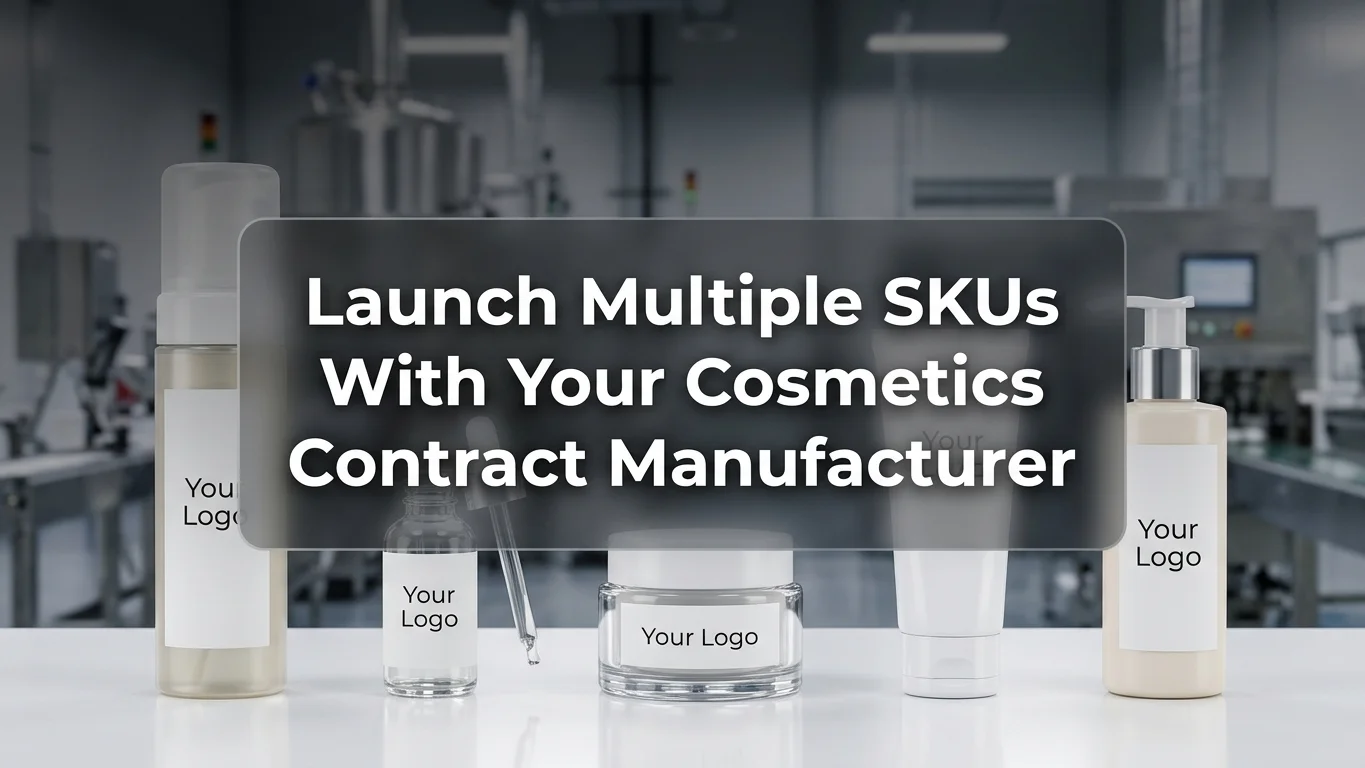
Launching a single product with a producator de produse cosmetice contract is relatively straightforward. Launching five SKUs at once — a cleanser, a serum, Un hidratant, a sunscreen, and a body lotion that all need to arrive at your warehouse on the same date, with coordinated branding, and within a budget that doesn’t sink your business — is an entirely different challenge. It’s also exactly how most real-world beauty brands launch.
The reality is that most brand founders plan multi-SKU launches. A 2024 raport de la Euromonitor International found that new beauty brands entering the market with three or more SKUs in their initial line saw 40% higher first-year retail sell-through rates compared to single-product launches. Consumers expect cohesive routines, nu produse izolate. Retailers expect shelf-ready collections. Amazon’s algorithm rewards brand storefronts with product depth. Yet the production coordination behind multi-SKU launches is rarely discussed — and almost never addressed by contract manufacturers in their public-facing content.
This guide fills that gap. Whether you’re a first-time founder preparing a DTC skincare line or an established brand extending into a new category, you’ll find a practical playbook for coordinating simultaneous product development, optimizing production timelines, and reducing per-SKU costs when working with your manufacturing partner. Every framework here reflects processes used daily by vertically integrated manufacturers serving hundreds of global brands.
eu. Why Multi-SKU Launches Succeed — And Why They Fail
A. The Strategic Case for Launching Multiple Products Together
A cohesive product line tells a stronger brand story than a standalone hero product. When consumers encounter a complete skincare routine — cleanser, tratament, crema hidratanta, SPF — they perceive the brand as more established, more trustworthy, and more worth trying. Conform McKinsey’s Consumer Packaged Goods insights, brands that launch with a curated assortment generate higher average order values (AOV) and stronger repeat purchase rates because they capture a larger share of the consumer’s routine from day one.
În special pentru vânzătorii Amazon FBA, multi-SKU storefronts unlock cross-selling, “cumpărate frecvent împreună” placements, and the ability to run A+ Content that positions your brand as a complete solution rather than a one-trick product.
B. The Coordination Failures That Derail Multi-Product Launches
Despite the advantages, multi-SKU launches fail for predictable, avoidable reasons. The most common include:
- Staggered formulation timelines: A vitamin C serum may require 12 weeks of stability testing while a basic cleanser needs only 8, creating misaligned production readiness.
- Fragmented packaging procurement: Ordering bottles, borcane, tuburi, and pumps from different suppliers leads to inconsistent lead times and missed synchronization windows.
- Uncoordinated production scheduling: Without centralized planning, one SKU finishes production weeks before the others, racking up warehousing costs or forcing partial shipments.
- Budget overruns from duplicate processes: Paying separately for each SKU’s quality testing, documentație de reglementare, and shipping instead of consolidating these steps.
Every one of these failures traces back to the same root cause: treating a multi-SKU launch as several independent single-product projects running in parallel, rather than as one integrated production program.
II. The Multi-SKU Production Planning Framework
A. Mapping Your SKU Matrix Before Contacting Your Manufacturer
Before reaching out to any manufacturing partner, organize your product line into a clear SKU matrix. This document becomes the single source of truth for every subsequent conversation about timelines, cheltuieli, and production sequencing.
| SKU | Product Type | Formulation Complexity | Packaging Type | Estimated MOQ | Stability Testing Duration |
|---|---|---|---|---|---|
| SKU-001 | Gel Cleanser | Scăzut | Tub + flip cap | 5,000 unități | 8 săptămâni |
| SKU-002 | Ser cu vitamina C | Ridicat (active stability) | Airless pump bottle | 5,000 unități | 12 săptămâni |
| SKU-003 | Barrier Moisturizer | Mediu | Jar + spatula | 5,000 unități | 8 săptămâni |
| SKU-004 | SPF 50 Cremă de protecție solară | Ridicat (de reglementare) | Tub + screw cap | 10,000 unități | 12 săptămâni (+ Testarea SPF) |
| SKU-005 | Lotiune de corp | Scăzut | Pump bottle | 5,000 unități | 8 săptămâni |
This matrix immediately reveals that SKU-002 and SKU-004 are the longest-lead items. They dictate your critical path. Every other SKU’s timeline should be scheduled backward from these two products’ completion dates.
B. The Critical Path Method Applied to Cosmetics Production
In project management, cel critical path is the longest sequence of dependent tasks that determines the minimum total timeline. For a multi-SKU cosmetics launch, the critical path nearly always runs through whichever product has the longest combined formulation development plus stability testing plus regulatory clearance timeline.
Here’s the practical application: start your most complex SKUs first. Begin formulation development for your active-heavy serums and sunscreens 4-6 weeks before your cleansers and body lotions. This staggered start creates a synchronized finish — all products reach production readiness within the same 1-2 week window.
Avantajul Ausmetics: Cu 28+ years of cosmetics contract manufacturing experience and a vertically integrated facility in Guangzhou, Ausmetice assigns dedicated project managers who build reverse-engineered timelines across all SKUs from day one. This means your vitamin C serum enters formulation on week one while your cleanser starts on week four — and both hit the production floor on the same date. Across 600+ brand partners, this synchronized scheduling approach is the single most effective tool for on-time multi-SKU delivery.
III. Formulation Strategies That Save Time and Money Across SKUs
A. Shared Base Formulas and Platform Technology
One of the least-discussed cost efficiencies in multi-SKU production is base formula sharing. Many products within a skincare line can share 60-80% of their formulation architecture — the emulsion system, the preservation system, the primary humectant blend — while differentiating through active ingredients, parfum, and texture modifiers.
De exemplu, a moisturizer and a body lotion might share an identical oil-in-water emulsion base. The moisturizer gets ceramides and peptides at specific concentrations; the body lotion gets shea butter and allantoin. Same base, different actives, two distinct products. This approach reduces R&D hours because the base system only needs to be developed and stability-tested once.
An experienced R&D team — particularly one led by formulators with global regulatory experience — can identify these shared-platform opportunities during your initial product briefing. Rezultatul: fewer formulation cycles, faster development, and lower per-SKU R&D Costuri.
B. Coordinated Stability Testing Protocols
Stability testing is a mandatory step that verifies your product remains safe and effective over its stated shelf life. For a single SKU, accelerated stability testing typically runs 8-12 weeks under controlled temperature and humidity conditions, following guidelines consistent with ISO 22716 O bună practică de fabricație Standarde.
For multi-SKU launches, smart manufacturers batch stability testing entries. Instead of staggering five separate SKUs into the stability chamber on five different dates, all formulations that reach final-formula approval within a two-week window enter testing together. This creates a single stability completion date rather than five scattered ones — which simplifies downstream production scheduling enormously.
Products with inherently longer stability requirements (ca sunscreen formulations requiring additional SPF validation) should begin formulation development first, as noted in the critical path discussion above.
IV. Packaging Procurement and Consolidated Sourcing
A. Why Packaging Is Usually the Biggest Timeline Risk
In most multi-SKU launches, packaging — not formulation — is the bottleneck. Custom molds for unique bottle shapes take 30-45 zile. Decorated components (captură ecran, ștanțare la cald, etichetarea) add another 10-15 zile. If you’re sourcing bottles from one supplier, pumps from another, and caps from a third, aligning delivery dates becomes a logistics puzzle that frequently fails.
The solution is consolidated packaging procurement: sourcing as many components as possible through a single, vertically integrated supply chain. When your contract manufacturer handles packaging sourcing in-house or through established supplier networks, they can negotiate bulk pricing across your entire SKU range and coordinate delivery windows to match production schedules.
B. The 15-25% Cost Savings From Consolidated Packaging Orders
Ordering packaging for five SKUs through a single coordinated procurement process typically saves 15-25% compared to placing five independent orders. The savings come from three sources:
- Volume consolidation: Ordering 25,000 total units of packaging components (across all SKUs) qualifies for price breaks that 5,000-unit individual orders cannot access.
- Shared tooling costs: If multiple SKUs use similar bottle shapes or cap styles, tooling costs are amortized across a larger production run.
- Reduced shipping costs: One consolidated packaging shipment to the manufacturing facility instead of five separate deliveries.
| Procurement Approach | Typical Cost Per Unit (Ambalare) | Lead Time Coordination | Risk of Delays |
|---|---|---|---|
| Independent sourcing per SKU | $0.80 - $1.50 | Uncoordinated (each supplier on own schedule) | Ridicat |
| Consolidated through manufacturer | $0.55 - $1.10 | Synchronized (manufacturer manages all suppliers) | Scăzut |
| Manufacturer’s in-house packaging | $0.45 - $0.95 | Fully integrated with production schedule | Very Low |
These savings compound significantly when you’re launching 5-7 SKU-uri la 5,000-10,000 unități fiecare. On a hypothetical 35,000-unit combined order, the difference between independent sourcing and consolidated procurement can exceed $10,000 — capital that’s better deployed toward marketing your launch.
Avantajul Ausmetics: Ca producător de produse cosmetice de vârf with in-house packaging capabilities and established supplier relationships built over 28+ ani, Ausmetics consolidates packaging procurement across your entire SKU range. The result is not only cost savings but timeline certainty — all packaging components arrive at the production facility according to a single, integrated schedule managed by your dedicated project team.
V. Synchronized Production Scheduling and Shipping
A. The Production Sequencing Logic
Once formulations are approved and packaging components are staged, the production floor needs to process multiple SKUs in the most efficient order. The general sequencing logic follows two principles:
- Light to dark, mild to strong: Production lines are sequenced from the lightest-colored, least-fragrant products to the darkest, most intensely scented. A clear gel cleanser runs before a tinted sunscreen. This minimizes line cleaning time between SKUs and reduces cross-contamination risk.
- Shared equipment grouping: Products that use the same filling equipment (de exemplu, all tube-fill products) run back-to-back. Products requiring different equipment (jar filling vs. airless pump filling) are grouped separately. This reduces changeover downtime.
A well-coordinated production run for five SKUs can often be completed within 5-7 production days when sequenced intelligently, comparat cu 12-15 days when each SKU is scheduled independently with full line breakdowns between each run.
B. Consolidated Quality Control and Shipping
După producție, each SKU undergoes quality control inspection — microbiological testing, verificarea greutății umplerii, verificări de integritate a ambalajului, and label accuracy review. For multi-SKU orders, these QC steps can run simultaneously across products rather than sequentially, compressing the total QC timeline.
Consolidated shipping is the final and often most overlooked cost savings. Shipping five SKUs in a single container load rather than five separate LCL (Less than Container Load) shipments can reduce freight costs by 30-40%. Your manufacturer should palletize and organize shipments so that all SKUs arrive at your fulfillment center together, ready for a coordinated launch.
În special pentru vânzătorii Amazon FBA, this means all SKUs can be sent to Amazon fulfillment centers in one inbound shipment, simplifying inventory receiving and enabling a simultaneous listing activation across your entire product line.
VI. The Multi-SKU Launch Timeline — From Brief to Delivery
Understanding the full timeline helps you plan backward from your target launch date. Below is a realistic timeline for a five-SKU skincare line coordinated through an experienced OEM/ODM cosmetics manufacturer:
| Fază | Activities | Durată | Cumulative Weeks |
|---|---|---|---|
| 1. Product Briefing & SKU Matrix | Define all SKUs, revendicări țintă, preferințele de ambalare, Moqs | 1-2 săptămâni | Săptămână 1-2 |
| 2. Dezvoltarea formulării | Staggered start: complex SKUs first, simpler SKUs 3-4 weeks later | 4-8 săptămâni | Săptămână 2-10 |
| 3. Sample Approval | Bench samples, texture/scent refinement, brand owner sign-off | 2-3 săptămâni | Săptămână 10-13 |
| 4. Testare de stabilitate | Batched entry for all approved formulas; accelerated stability protocols | 8-12 săptămâni | Săptămână 13-25 |
| 5. Packaging Procurement | Consolidated order (runs parallel with stability testing) | 6-8 săptămâni | Săptămână 13-21 |
| 6. Producția în vrac | Sequenced production runs across all SKUs | 2-3 săptămâni | Săptămână 25-28 |
| 7. QC & Transport | Consolidated quality inspection and container loading | 2-3 săptămâni | Săptămână 28-31 |
Total estimated timeline: 28-31 weeks from initial briefing to delivery. Notice that packaging procurement runs in parallel with stability testing — this parallelization is what keeps the total timeline at roughly seven months rather than stretching to ten or eleven months with sequential processing.
The key insight for brand founders: if you want to launch for a specific retail season (holiday, summer, back-to-school), count backward 8 months from your ideal in-market date and start your manufacturer conversations at that point.
Întrebări frecvente
What is the minimum number of SKUs I should launch simultaneously?
While there is no strict minimum, most successful skincare brand launches include 3-5 SKUs that form a logical consumer routine. De exemplu, a cleanser, a treatment product (serum or essence), and a moisturizer represent the minimum viable routine. Adding a sunscreen and a specialty product (crema de ochi, masca, sau îngrijirea corpului) rounds out the offering to five SKUs. The coordination efficiencies and cost savings from consolidated production and packaging procurement become most meaningful at the three-SKU threshold. Launching fewer than three products still works, but you may not benefit as substantially from bulk sourcing discounts and consolidated shipping.
How much can I save by launching multiple SKUs together versus one at a time?
The savings vary depending on formulation complexity, alegerile de ambalare, and order quantities, but most brands see 15-25% lower per-unit packaging costs through consolidated procurement and 30-40% lower freight costs through combined shipping. R&D savings from shared base formulas can reduce per-SKU formulation costs by 20-30%. On a five-SKU launch with 5,000 unități pe sku (25,000 unități totale), these combined efficiencies can represent $8,000-$15,000 in savings compared to developing and shipping each product independently over separate timelines.
What happens if one SKU fails stability testing while the others pass?
This is precisely why the staggered-start approach is so valuable. If a complex formulation (such as a vitamin C serum) encounters a stability issue, the reformulation and re-testing happen while simpler SKUs continue through their own testing cycles. A skilled cosmetics contract manufacturer will have contingency protocols: the failed SKU is reformulated and re-enters accelerated stability testing, and the production schedule is adjusted so the remaining SKUs proceed without delay. În unele cazuri, brands choose to launch with four SKUs on time and add the fifth SKU 6-8 weeks later rather than holding the entire launch for one product.
Do I need separate regulatory filings for each SKU?
da, each SKU requires its own regulatory documentation, including product information files, ingredient lists (INCI), Evaluări de siguranță, and market-specific registrations (such as FDA facility registration for the U.S. market or NMPA filing for China). in orice caz, when working with a manufacturer that handles regulatory support, these filings are prepared in parallel across all SKUs, often using shared templates and documentation frameworks. This parallel processing means five regulatory files take only marginally longer than one — perhaps an additional week rather than five times the effort.
Can I mix different product categories (îngrijire a pielii, îngrijirea părului, îngrijire corporală) in one multi-SKU order?
da, and many brands do exactly this — particularly those launching on Amazon or DTC platforms where a broader product catalog improves storefront performance. The key requirement is that your manufacturer has the equipment, expertiză, and regulatory knowledge across all categories. A vertically integrated facility that produces îngrijire a pielii, îngrijirea părului, și îngrijire corporală under one roof can coordinate cross-category multi-SKU orders using the same synchronized scheduling and consolidated shipping principles described in this guide.
Concluzie și pași următori
Launching multiple SKUs simultaneously is not just a logistical challenge — it’s a strategic advantage when executed with the right planning framework and the right manufacturing partner. The brands that launch cohesive product lines on time and within budget are the ones that treat multi-SKU coordination as a single integrated program, not a collection of independent projects.
Principiile de bază sunt simple: map your SKU matrix early, identify your critical path products, stagger formulation starts to create synchronized finishes, consolidate packaging procurement, sequence production runs for efficiency, and ship everything together. Each of these steps compounds savings and reduces timeline risk.
If you’re planning a multi-product launch — whether it’s your first three SKUs or an expansion of twenty — the most important decision you’ll make is choosing a producator de produse cosmetice contract with the vertical integration, project management infrastructure, and production capacity to coordinate every element under one roof. Cu 28+ Ani de experienta, ISO 22716 și certificări GMPC, Înregistrare FDA, Sedex-audited ethical standards, și un R premiat IFSCC&Echipa D condusă de Dr. Jadir Nunes, Ausmetics coordinates multi-SKU launches daily for over 600 global brand partners from its integrated Guangzhou facility.
Ready to start planning your multi-SKU launch? Luați legătura cu echipa Ausmetics with your initial SKU matrix, target launch date, and order quantities. A dedicated project manager will map your reverse-engineered timeline and identify every shared-formula and consolidated-procurement opportunity available across your product line.