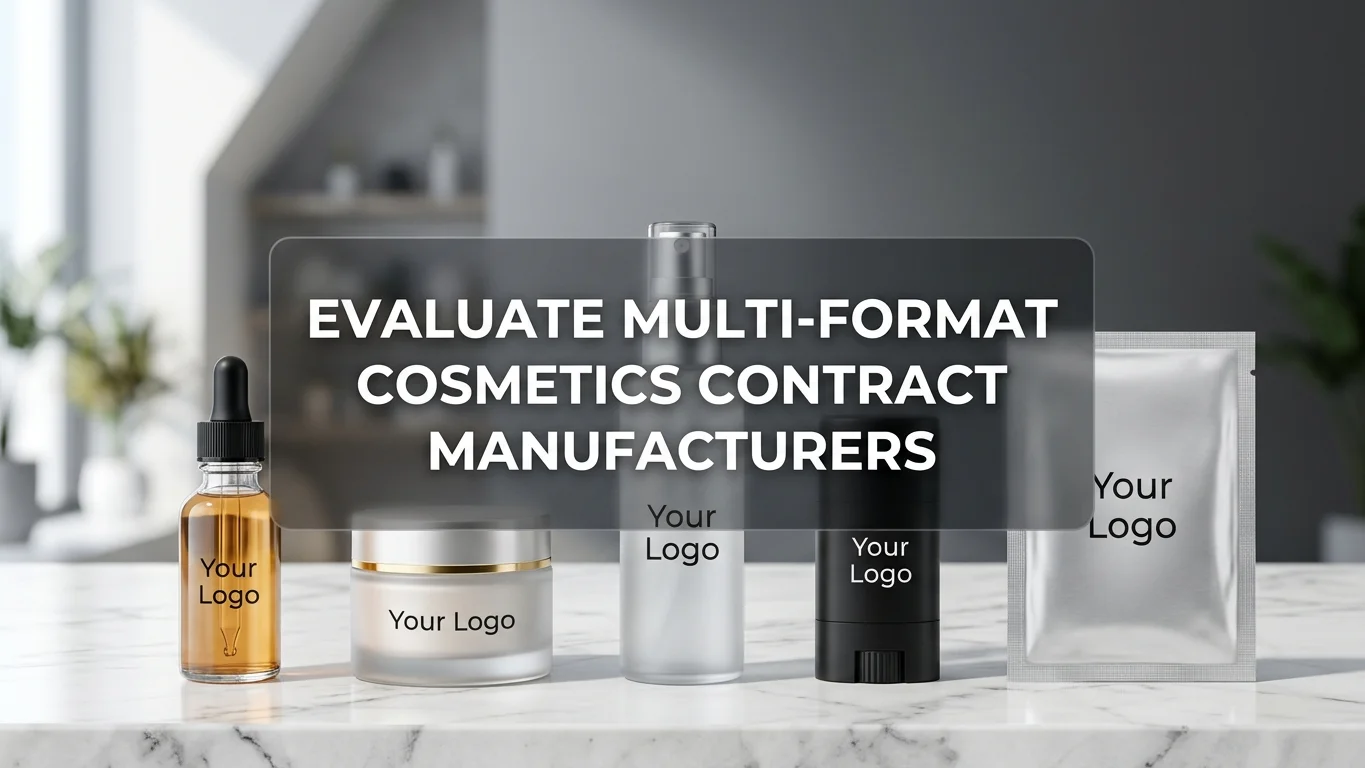
When your beauty brand spans serums, кремы, туманы, stick balms, and transdermal patches, the last thing you want is to coordinate production across three or four separate factories. Yet that is exactly what happens when founders choose a контрактный производитель косметики without first verifying its multi-format production capabilities. Each additional factory adds a new quality system to audit, a new logistics chain to manage, and a new point of failure that can delay an entire product launch.
The financial impact is significant. Brands that split production across multiple facilities typically see coordination overhead increase costs by 25–40% compared to single-source manufacturing. Beyond cost, there are regulatory risks: different factories may interpret stability testing or preservative efficacy protocols differently, creating inconsistencies that surface during FDA or EU Cosmetic Regulation audits. This guide gives you a practical framework — including a downloadable-ready scorecard — for evaluating whether a prospective manufacturing partner can genuinely handle every product format in your portfolio under one roof.
Whether you are an indie founder building your first five-SKU line, an Amazon FBA seller expanding into new categories, or an established retail brand rationalizing your supply chain, the evaluation criteria below will help you ask the right questions before you sign a single contract.
я. Why Multi-Format Capability Matters More Than Ever
А. The Modern Beauty Portfolio Is Format-Diverse
Today’s consumer expects a brand to offer a coherent routine, not just a single hero product. A typical skincare line now includes 5–7 distinct product formats: water-phase serums, oil-in-water or water-in-oil emulsions (creams and lotions), распыление тумана, anhydrous sticks (lip balms, солнцезащитные палочки, deodorant-style treatments), sheet or hydrogel masks, и все чаще, microstructure patches such as dissolving microneedle arrays. Each format demands specialized equipment, different filling environments, and unique quality-control checkpoints.
В соответствии с Grand View Research, the global cosmetics market is projected to surpass USD 480 миллиард на 2030, with much of that growth driven by format innovation — particularly in patches and solid-format treatments. If your manufacturer cannot keep pace with these formats, your product development pipeline stalls.
Б. The Hidden Cost of Multi-Factory Production
Splitting your product line across manufacturers introduces risks that are not immediately visible on a cost sheet:
- Duplicated qualification audits. Each new factory requires a separate GMP audit, quality agreement, and supplier qualification file — easily consuming 60–120 hours of your team’s time per facility.
- Fragmented R&D feedback loops. When your serum factory discovers a stability issue with a shared active ingredient, that insight rarely reaches your stick-format factory in time to adjust formulation.
- Inventory complexity. Shared raw materials (гиалуроновая кислота, ниацинамид, SPF actives) must be procured, протестирован, and shipped to multiple locations instead of drawn from a single qualified warehouse.
- Regulatory inconsistency. Different facilities may use different testing labs, different reference standards, or different interpretations of ИСО 22716 Хорошая производственная практика требования, creating documentation gaps during regulatory submissions.
Преимущество асметики: С участием 28+ years of contract manufacturing experience and a vertically integrated facility in Guangzhou, Аусметика houses dedicated production lines for liquid fills, emulsion processing, anhydrous stick molding, spray filling, patch lamination, and mask sachet sealing — all under one ISO 22716-certified, Зарегистрирован FDA, and Sedex-audited roof. This consolidation eliminates the coordination tax that multi-factory setups impose on growing brands.
II. The Six Core Product Formats and What Each Demands from a Manufacturer
Before you can evaluate a manufacturer, you need to understand what each format requires at the production level. The table below maps the six most common beauty-product formats to their critical manufacturing requirements.
| Product Format | Key Equipment Required | Critical Quality Checkpoints | Common Production Pitfalls |
|---|---|---|---|
| Сыворотки (water-phase liquids) | Precision liquid filling lines, homogenizers, inline filtration | Viscosity consistency, particulate-free clarity, pH stability | Air entrainment during filling; foaming of surfactant-containing formulas |
| Кремы & Лосьоны (emulsions) | High-shear emulsification kettles, vacuum mixing, temperature-controlled tanks | Droplet-size distribution, emulsion stability at 40°C/75% RH, микробные пределы | Phase separation after three-month accelerated stability; inconsistent texture between batches |
| Spray Mists | Propellant or pump-spray filling lines, pressure-test stations, crimping machines | Spray pattern uniformity, valve seal integrity, delivered-dose accuracy | Clogged nozzles with particulate-containing formulas; inconsistent actuation force |
| Sticks (anhydrous) | Heated pour-and-mold systems, cooling tunnels, stick-filling carousels | Hardness/melting-point range, surface bloom testing, break strength | Wax bloom (white film) during temperature cycling; uneven fill heights |
| Patches (hydrogel, микроиглы, hydrocolloid) | Lamination presses, die-cutting stations, controlled-environment sealing | Adhesion force (peel test), active-ingredient loading uniformity, moisture barrier of pouch | Delamination at edges; moisture ingress degrading active before use |
| Sheet Masks & Sachets | Automated mask-folding and essence-filling machines, sachet heat-sealers | Essence volume accuracy (±2%), целостность уплотнения, substrate fit across face sizes | Leaking seals; uneven essence saturation causing dry spots on the mask |
A manufacturer that claims multi-format capability should be able to walk you through the specific equipment, СОПы, and quality checks for every format in this table. If a factory representative hesitates or gives vague answers when you ask about stick-molding cooling tunnel temperatures or patch-lamination peel-test standards, that is a reliable signal they outsource or subcontract that format.
III. The Manufacturing Versatility Scorecard — A Practical Evaluation Tool
А. How to Use the Scorecard
Rate each criterion on a 0–3 scale during your factory audit, video call, or RFI (Request for Information) процесс. A score of 0 means the manufacturer has no capability; 1 means they subcontract it; 2 means they have in-house equipment but limited track record; а также 3 means they have dedicated, proven production lines with documented batch history. Tally the results to get a composite versatility score.
| Критерий оценки | Что спросить / Verify | Счет (0–3) |
|---|---|---|
| Liquid / serum filling lines | Request photos or video of filling line; ask for recent batch records showing fill-weight RSD < 1% | |
| Emulsion processing (cream/lotion) | Ask for emulsification kettle specs (емкость, max RPM, vacuum capability); request a stability study sample | |
| Спрей / mist filling and crimping | Verify spray pattern test reports; ask whether they handle both pump sprays and aerosol propellant fills | |
| Anhydrous stick molding | Ask for melting-point range data on recent stick products; request break-strength test results | |
| Patch or film lamination | Request peel-adhesion test data (ASTM D3330 or equivalent); verify cleanroom or controlled-environment sealing | |
| Sheet mask / sachet sealing | Ask for essence fill-volume accuracy records; request seal-burst-pressure test data | |
| Shared raw-material qualification | Confirm whether a single QC lab tests and releases raw materials for all formats | |
| Cross-format R&команда Д | Ask whether the same formulation chemists work across product categories or if teams are siloed | |
| Unified regulatory documentation | Verify that a single regulatory affairs team prepares PIF, КПСР, or FDA registration documents for all SKUs | |
| Single-site certification coverage | Confirm that ISO 22716, НПП, and any additional certifications (регистрация FDA, FedEx) cover the entire facility, not just one wing |
Б. Interpreting Your Score
- 25–30 points: True multi-format partner. This manufacturer can likely serve as your single-source production hub.
- 18–24 points: Strong in most formats but may need to subcontract 1–2 categories. Clarify which formats are outsourced and evaluate the subcontractor’s quality system.
- Ниже 18 points: Format specialist, not a multi-format partner. Suitable if you only need 1–2 product types; otherwise, expect to manage multiple suppliers.
Например, a manufacturer that scores 3 on serums and creams but 0 on patches and sticks is essentially a liquid-and-emulsion house. Partnering with them for your entire line means your stick sunscreen and microneedle patches will be subcontracted — often without your direct oversight of the subcontractor’s quality practices.
IV. Five Critical Questions to Ask During Factory Evaluation
А. Equipment and Facility Questions
- “Can I see the dedicated production area for each format I need?” A genuine multi-format facility will have physically distinct zones — liquid filling in one area, anhydrous stick molding in another, patch lamination in a controlled-humidity room. If everything runs through a single general-purpose filling line, the manufacturer is improvising, not engineering for format diversity.
- “What is your changeover protocol between product formats on shared lines?” Some equipment, such as filling nozzles and mixing vessels, may be shared across formats. That is acceptable if the manufacturer has validated cleaning and changeover SOPs that prevent cross-contamination. Ask to see the written changeover procedure and recent cleaning-validation records.
Б. р&D and Formulation Questions
- “Does the same R&D team formulate across all product formats, or are teams siloed?” A unified R&D team can identify opportunities to use the same active complex across multiple formats — your vitamin C serum and vitamin C patch can share a stabilized ascorbic acid derivative, ensuring brand consistency and reducing raw-material procurement complexity. Siloed teams rarely achieve this.
- “Can you show me stability data for at least one product in each format category?” Stability testing protocols differ by format. Emulsions undergo centrifuge and thermal-cycling tests; sticks are tested for bloom and break strength; patches need adhesion-force and moisture-permeation data. A manufacturer experienced in all formats will have this data readily available, organized by category.
С. Supply Chain and Regulatory Questions
- “Is your entire facility covered under a single ISO 22716 certificate and a single FDA registration number?” Some manufacturers operate multiple buildings or subcontract specific formats to nearby facilities, each with its own (or no) сертификация. A single certificate covering all production areas gives you one audit point, one quality system, and one chain of accountability.
These five questions alone will eliminate a significant portion of manufacturers who market themselves as “full-service” but actually specialize in one or two formats and broker the rest.
Преимущество асметики: Аусметика’ р&Дивизия Д, под руководством доктора. Джадир Нуньес — бывший глобальный президент Международная федерация обществ химиков-косметологов (IFSCC) и бывший Джонсон & Johnson — operates a cross-format formulation lab where chemists develop serums, emulsions, anhydrous systems, spray formulations, and patch matrices within a single quality ecosystem. С участием 28+ years of experience serving 600+ мировые косметические бренды, the team has formulated across every major product category, and the entire Guangzhou facility operates under unified ISO 22716, ГМПК, FDA, and Sedex certifications.
В. Consolidation in Practice — How Single-Source Manufacturing Protects Your Brand
А. Coordinated Launch Timelines
When you launch a five-SKU collection — say, с конца, увлажняющий крем, a mist toner, a lip balm stick, and a hydrogel eye patch — timing is everything. Retailers expect all SKUs to arrive together. Consumers expect the full routine to be available on launch day. If your serum factory finishes four weeks before your patch factory even begins, you either warehouse inventory (tying up cash) or stagger your launch (diluting marketing impact).
A single-site опытный контрактный производитель косметики can synchronize production schedules across all formats, aligning filling, упаковка, and QC release so your entire collection ships in one consolidated freight booking. This reduces warehousing dwell time and lets you plan marketing campaigns around a firm, unified ship date.
Б. Ingredient Synergy and Cost Efficiency
When one facility purchases niacinamide for your serum, your cream, and your patch, the combined volume often qualifies for better raw-material pricing tiers. Важнее, a single QC lab qualifies that niacinamide once and applies the same Certificate of Analysis across every format. With multiple factories, each one independently qualifies and tests the same ingredient — tripling the testing cost and introducing the risk of specification drift between suppliers.
С. Unified Quality Documentation for Regulatory Submissions
Если вы продаете в ЕС, each product requires a Product Information File (Пиф) и отчет о безопасности косметической продукции (КПСР). В США, FDA registration and voluntary MoCRA compliance increasingly require detailed manufacturing-site information. When all products come from one registered, Сертифицированное учреждение, your regulatory binder is cleaner, your Responsible Person’s job is simpler, and your audit trail is unbroken.
VI. Red Flags That Signal Limited Format Capability
Во время процесса оценки, watch for these warning signs that suggest a manufacturer is overstating its multi-format range:
- Vague answers about equipment specifics. A manufacturer that genuinely operates a stick-molding line will know the exact pour temperature range for their carnauba-beeswax base. If the answer is “we can figure it out,” they are learning on your dime.
- No batch records for certain formats. Ask for a redacted batch record from each format category. If the manufacturer cannot produce one for sticks or patches, those formats are likely subcontracted.
- Multiple addresses on certifications. If the ISO 22716 certificate lists one address but the patch production happens at a different location, you have a split-site situation that requires a separate audit.
- Unwillingness to allow a factory tour of all production zones. Legitimate multi-format facilities are proud of their range and want to show you every line. Restricted access to certain areas often means those areas do not exist or do not meet your expected standards.
- Dramatically different lead times by format. If serums quote 4 weeks but patches quote 14 недели, the patch production is likely outsourced to a third party whose schedule the manufacturer does not control.
Apply these red-flag checks alongside the scorecard from Section III to build a comprehensive picture of any prospective partner’s true capabilities.
Часто задаваемые вопросы
How many product formats should a cosmetics contract manufacturer be able to produce in-house?
A truly versatile cosmetics contract manufacturer should be able to produce at least four to six distinct product formats — including liquids (сыворотки, тонеры), emulsions (кремы, лосьоны), спреи, anhydrous solids (палочки, бальзам), and at least one advanced format like patches or sheet masks — all within a single certified facility. If your brand’s roadmap includes five or more formats, consolidating with a manufacturer that handles all of them in-house eliminates the coordination complexity and cost escalation associated with managing multiple factories.
What certifications should I verify when evaluating a multi-format manufacturer?
Как минимум, confirm that the facility holds ISO 22716 (Косметика GMP) certification and that the certificate’s scope covers all production areas, not just one wing or building. Для брендов, продающих в США, verify active FDA facility registration. Sedex or SMETA audits add a layer of ethical-manufacturing verification. ГМПК (Guidelines for Good Manufacturing Practice of Cosmetic Products) is another widely recognized standard. Критически, ensure the single certificate or registration number applies to every format line you intend to use — not just the main emulsion area.
How does working with one multi-format manufacturer reduce costs compared to using multiple factories?
Single-source manufacturing reduces costs in several measurable ways. Первый, shared raw-material procurement across formats unlocks volume-based pricing. Второй, you eliminate duplicated QC testing — one lab qualifies ingredients once for use in every product. Третий, you consolidate shipping into fewer freight bookings. Fourth, you reduce internal overhead: one supplier audit instead of three or four, one quality agreement, one communication channel. Коллективно, these efficiencies can lower per-unit landed cost by 25–40% compared to a split-factory approach, particularly for brands with portfolios spanning five or more SKUs in different formats.
Can a single manufacturer maintain quality across very different product types like serums and patches?
Да, provided the manufacturer operates dedicated equipment and trained personnel for each format. The key indicator is whether they have format-specific production lines rather than a single general-purpose line adapted on the fly. A well-run multi-format facility will have separate areas for liquid processing, emulsion compounding, anhydrous molding, and patch lamination, each with its own SOPs, environmental controls, and quality checkpoints. Ask to review format-specific batch records and stability data as proof that quality standards are consistently met across all product types.
What is the best way to start evaluating a cosmetics contract manufacturer’s multi-format capabilities?
Begin with a detailed Request for Information (RFI) that lists every product format in your current and planned portfolio. Ask the manufacturer to respond with equipment specifications, recent batch-record examples (redacted for confidentiality), данные о стабильности, and certification documentation for each format. Follow up with a factory tour — virtual or in-person — and use the Manufacturing Versatility Scorecard outlined in this guide to assign objective scores. Comparing two or three manufacturers using the same scorecard gives you an apples-to-apples basis for your final decision.
Заключение и следующие шаги
Evaluating a cosmetics contract manufacturer’s multi-format capability is not an optional refinement — it is a foundational decision that shapes your brand’s cost structure, launch speed, постоянство качества, and regulatory readiness for years to come. The scorecard and question framework in this guide give you a structured, repeatable way to separate genuinely versatile manufacturing partners from single-format specialists who market themselves as full-service providers.
Start by mapping your current and 18-month-projected product portfolio by format. Then use the Manufacturing Versatility Scorecard to assess at least two to three prospective manufacturers. Prioritize those that score 25 или выше, hold unified ISO 22716 certification across all production zones, and can produce format-specific batch records on request.
If you are looking for a надежный партнер по контрактному производству косметики с 28+ Годы опыта, Отмеченный наградой IFSCC R&Д лидерство, and the ability to produce serums, кремы, спреи, палочки, патчи, and masks from a single Guangzhou facility, Аусметика invites you to put this scorecard to the test. Свяжитесь с командой Ausmetics with your product format list, and receive a detailed capability brief tailored to your brand’s specific portfolio needs.