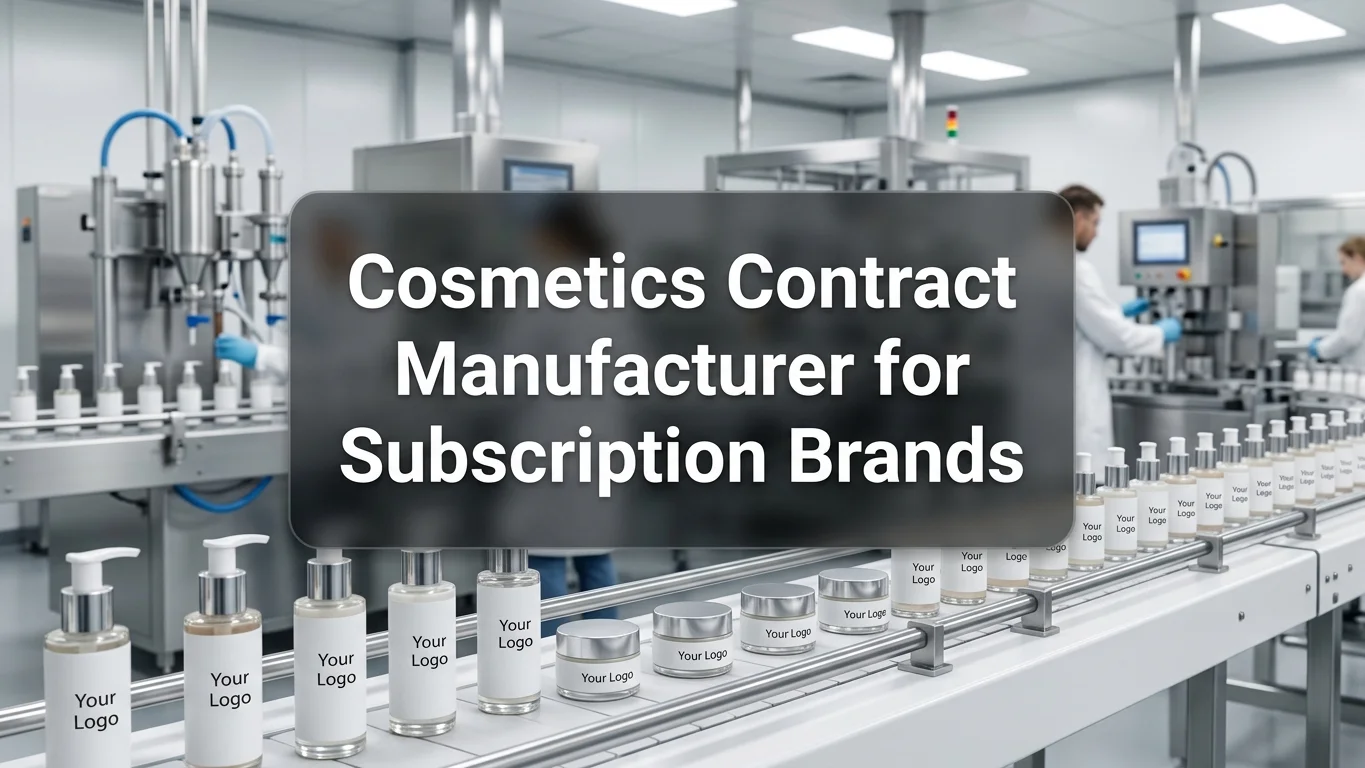
Výber a zmluvný výrobca kozmetiky for a subscription or auto-replenishment brand is a fundamentally different decision than sourcing a one-time product run. When your customers expect a curated box or a refill shipment on a predictable cycle — every 30, 60, alebo 90 days — a single stockout doesn’t just cost you a sale. It triggers cancellations, erodes lifetime value, and fractures the trust that subscription models are built on.
Subscription beauty is one of the fastest-growing segments in direct-to-consumer commerce. Podľa McKinsey & Company subscription commerce research, replenishment subscriptions in particular show stronger retention rates than curation models, precisely because they fulfill a recurring need the customer already trusts. Pre zakladateľov kozmetických značiek, Predajcovia Amazon FBA, and indie skincare entrepreneurs, meeting that trust requires a manufacturing partner built for continuous production — not a factory that treats every purchase order as an isolated transaction.
This guide breaks down the operational architecture behind subscription-ready cosmetics manufacturing: how to structure rolling forecasts, pre-stage raw materials, manage buffer inventory, and build a fulfillment partnership that scales with your subscriber base rather than collapsing under its weight.
ja. Why Subscription Brands Need a Different Kind of Manufacturing Relationship
A. The Structural Gap Between One-Off and Recurring Production
Traditional contract manufacturing follows a linear sequence: you place an order, the factory schedules production, ships the batch, and the relationship pauses until the next PO. That model works when your sales are campaign-driven or retail-seasonal. It fails entirely when you have 5,000 subscribers expecting a shipment on the first of every month.
Subscription and auto-replenishment brands operate on continuous demand curves, not discrete order spikes. The production relationship must mirror that continuity. This means your manufacturer needs to maintain dedicated production slots, hold safety stock of key raw materials, and forecast future runs based on your subscriber growth trajectory — not wait for you to submit a new purchase order every cycle.
The practical difference looks like this:
| Schopnosť | Transactional Manufacturer | Subscription-Ready Manufacturer |
|---|---|---|
| Plánovanie výroby | Per-order, first-come first-served | Reserved monthly or bi-monthly production windows |
| Zdroj surovín | Ordered after PO is confirmed | Pre-staged based on rolling 90-day forecast |
| Inventory management | Ships full batch; no buffer held | Maintains 15–20% buffer stock for demand surges |
| Communication cadence | Per-project, ad hoc | Dedicated project manager with weekly or biweekly reviews |
| Scalability response time | 4–8 weeks for new run | 2–3 weeks with pre-staged materials |
| Minimum order flexibility | High MOQs per SKU | Flexible MOQs aligned to subscriber volume |
B. What Stockouts Actually Cost a Subscription Brand
A Recharge State of Subscription Commerce report has consistently shown that involuntary churn — cancellations triggered by fulfillment failures rather than customer dissatisfaction — represents a significant percentage of total subscriber loss for beauty brands. Every missed shipment becomes a cancellation risk multiplied across your entire active subscriber base.
For a brand with 3,000 active subscribers paying $45/month, dokonca a 5% churn spike from a single stockout event represents $6,750 in lost monthly recurring revenue — and that compounds as those subscribers never return. The math makes the case for manufacturing continuity far more persuasively than any pitch deck.
Akčné odporúčanie: Pred podpísaním zmluvy s akýmkoľvek výrobným partnerom, ask specifically whether they offer reserved production windows for recurring clients. If the answer involves “submitting a new PO each time,” that factory isn’t structured for subscription commerce.
II. How to Structure Rolling 90-Day Production Forecasts
A. The Three-Horizon Forecast Framework
The most effective subscription brands don’t hand their manufacturer a single number and hope for the best. They use a three-horizon rolling forecast that gives the production facility increasingly firm commitments across a 90-day window:
- mesiac 1 (Firm commitment): Locked production quantities based on confirmed subscriber count plus projected new sign-ups from active marketing campaigns. This triggers raw material consumption and production scheduling.
- mesiac 2 (Strong estimate): Projected quantities based on historical growth rates and planned promotions. The manufacturer pre-stages packaging components and key active ingredients.
- mesiac 3 (Directional forecast): A range-based estimate (Napr., 8,000–12,000 units) that allows the manufacturer to reserve production capacity and place advance orders on long-lead-time ingredients.
This framework updates on a rolling basis — every month, a “Month 2” estimate becomes the new “Month 1” firm commitment, and a new “Month 3” directional forecast extends the planning horizon. Your manufacturer should be reviewing and adjusting these figures with you on a defined cadence.
B. Syncing Forecast Data with Your Subscription Platform
If you’re running your subscription program through platforms like Recharge, Bold, or Ordergroove, your active subscriber data, churn rates, and upcoming renewal dates are already available in near-real-time. The most operationally mature brands export this data monthly and share it directly with their manufacturing partner.
Akčné odporúčanie: Build a shared forecast spreadsheet or dashboard with your manufacturer that updates monthly. Include columns for: active subscribers, 30-day projected new sign-ups, expected churn, units per subscriber, and total production quantity per SKU. This single document becomes the operational backbone of your continuous fulfillment partnership.
Ausmetická výhoda: s 28+ od r. roky zmluvnej výroby kozmetiky 1998, Ausmetika assigns dedicated project managers to subscription brand accounts who participate in monthly forecast reviews. This isn’t a generic customer service channel — it’s an operational partnership where your production schedule is actively managed by someone who understands your growth curve, seasonal patterns, and SKU complexity across skincare, starostlivosť o vlasy, a starostlivosť o telo kategórie.
III. Pre-Staged Raw Materials and Buffer Inventory Management
A. Why Raw Material Lead Times Are Your Biggest Hidden Risk
Most subscription brand founders focus on finished goods lead times — how long from PO to shipment. But the real bottleneck sits further upstream. Specialty active ingredients like stabilized retinol, patentované peptidové komplexy, or high-grade hyaluronic acid can carry lead times of 6–12 weeks from suppliers, particularly when sourced from regulated markets in Europe, Japonsko, or South Korea.
If your manufacturer waits until you confirm quantities to order raw materials, you’ve already built 6–12 weeks of delay into every production cycle. For a monthly subscription cadence, that math simply doesn’t work.
A subscription-ready zmluvný výrobca kozmetiky pre-stages critical raw materials based on your rolling forecast. This means they hold inventory of your formula’s key ingredients in their warehouse, replenishing based on projected consumption rather than confirmed orders. You may share some of the carrying cost through minimum commitment agreements, but you eliminate the supply chain delay that causes stockouts.
B. Structuring Buffer Inventory Without Overcapitalizing
Buffer stock — finished goods held beyond your immediate fulfillment needs — is insurance against demand variability. For subscription brands, a common starting point is maintaining a 15–20% buffer above your confirmed subscriber count in finished goods, with the ability to flex up during high-growth periods (uvedenie produktov na trh, influencer campaigns, holiday promotions).
The key is structuring this buffer collaboratively with your manufacturer:
- Consignment arrangements: Some manufacturers will hold finished buffer stock in their warehouse at agreed terms, shipping incrementally as you draw down inventory.
- Shared risk models: You commit to purchasing buffer stock within a defined timeframe (Napr., 90 dni), and the manufacturer absorbs the warehousing cost.
- Trigger-based replenishment: When buffer stock drops below a defined threshold, production of the next batch is automatically initiated without requiring a new PO.
Akčné odporúčanie: Negotiate buffer inventory terms during your initial manufacturing agreement — not after your first stockout. Include specific language about who bears carrying costs, maximum storage duration, and the trigger point for automatic replenishment runs.
IV. Monthly and Bi-Monthly Production Cadences That Prevent Stockouts
A. Matching Production Frequency to Subscription Cycles
The cadence at which your manufacturer produces batches should align directly with your subscription billing and fulfillment cycles. If subscribers renew monthly, your manufacturing partner should be running production at least monthly — potentially more frequently if you manage multiple SKUs or offer customization options.
| Subscription Cycle | Recommended Production Cadence | Buffer Strategy |
|---|---|---|
| Mesačne (30-deň) | Monthly production with 2-week lead buffer | 20% above confirmed subscriber count |
| Bi-monthly (60-deň) | Monthly production, alternating SKUs | 15% buffer per SKU |
| Quarterly (90-deň) | Production every 6 weeks with mid-cycle adjustment | 15% buffer with quarterly review |
| Auto-replenishment (premenlivý) | Bi-monthly production with demand-triggered flex runs | 25% buffer to absorb renewal variability |
B. The Vertically Integrated Advantage for Recurring Production
Not all manufacturing facilities can accommodate frequent, smaller production runs efficiently. Factories optimized for high-volume, single-batch production often impose prohibitive setup charges for monthly cadences or deprioritize recurring clients in favor of larger one-off orders.
Vertically integrated manufacturers — those that control formulation, náplň, balenie, and quality testing under one roof — can schedule recurring runs with significantly lower changeover costs. They don’t need to coordinate with external filling houses or third-party packagers, which eliminates scheduling conflicts and reduces the turnaround window between production approval and shipment.
Ausmetická výhoda: Ausmetika’ vertically integrated manufacturing campus in Guangzhou houses R&D, formulácia, výroby, náplň, a zabezpečenie kvality in a single facility. This integration, podporované ISO 22716 Certifikácia a registrácia FDA, allows the company to run monthly production cycles for subscription clients without the coordination delays that fragmented supply chains introduce. R&D tím, pod vedením Dr. Jadir Nunes (bývalý globálny prezident IFSCC), also supports ongoing formula optimization — a valuable capability for subscription brands that need to iterate on products based on subscriber feedback without disrupting production continuity.
V. Building a Continuous Fulfillment Partnership: Contracts, Komunikácia, and KPIs
A. What Your Manufacturing Agreement Should Include
A subscription-ready manufacturing relationship requires contractual terms that go beyond standard PO-based agreements. Pri hodnotení akéhokoľvek skúsený zmluvný výrobca kozmetiky, ensure the agreement addresses:
- Reserved production capacity: Guaranteed production slots during specific weeks each month, with priority scheduling that doesn’t get bumped by larger orders.
- Forecast commitment and flexibility: Clear terms defining how much your forecast can flex month-to-month (typically ±15–20%) without triggering penalties or delays.
- Raw material pre-staging obligations: Who funds advance material purchases, maximum pre-staged inventory value, and what happens to materials if forecasts are revised downward.
- Quality consistency standards: Batch-to-batch consistency benchmarks for color, viskozita, vôňa, and active ingredient concentration — critical when subscribers receive the same product repeatedly and will notice variations.
- Communication protocols: Defined frequency of production reviews (weekly status updates, monthly forecast meetings), escalation paths for supply disruptions, and single points of contact on both sides.
B. Key Performance Indicators for Subscription Manufacturing Partnerships
Track these KPIs to measure whether your manufacturing partner is meeting the demands of a continuous fulfillment model:
- On-Time Production Rate: Percentage of production runs completed by the scheduled date. Cieľ: 95%+.
- Forecast Accuracy: How closely your rolling forecast matches actual production quantities consumed. Track to improve over time.
- Batch Consistency Score: Quality control metrics across consecutive batches. Subscriber complaints about product inconsistency signal a manufacturing process issue.
- Stockout Incidents: Number of times finished goods inventory hit zero before the next production run was complete. Cieľ: zero.
- Lead Time Reliability: Variance between quoted and actual lead times across multiple production cycles.
Akčné odporúčanie: Establish a quarterly business review cadence with your manufacturer where you review these KPIs together. This transforms the relationship from vendor-client into a genuine operational partnership where both parties optimize toward the same outcome: zero stockouts and predictable subscriber fulfillment.
Často kladené otázky
What makes a cosmetics contract manufacturer “subscription-ready”?
A subscription-ready cosmetics contract manufacturer offers reserved production windows, accepts rolling forecasts rather than requiring discrete purchase orders for every run, pre-stages raw materials based on projected demand, and maintains buffer inventory to absorb demand variability. They also assign dedicated project management resources and participate in regular forecast reviews. Kriticky, they must be able to run frequent, smaller production batches cost-effectively — something that requires vertical integration and flexible scheduling infrastructure rather than production lines optimized solely for large single runs.
How far in advance should I share production forecasts with my manufacturer?
Best practice for subscription and auto-replenishment brands is a rolling 90-day forecast updated monthly. mesiac 1 should be a firm, locked commitment. mesiac 2 should be a strong estimate with ±15% flexibility. mesiac 3 should be a directional range that allows your manufacturer to reserve capacity and begin long-lead-time procurement. As your subscriber base grows and your forecasting improves, some brands extend to 120-day or even 180-day horizons for ingredients with particularly long lead times.
How do I prevent overstock when subscriber growth slows?
Build flexibility into your manufacturing agreement from the start. Negotiate terms that allow you to adjust Month 2 and Month 3 forecast quantities by 15–20% without penalty. Use buffer stock minimally — typically 15–20% above confirmed subscribers — and review buffer levels monthly rather than letting excess inventory accumulate. If growth slows, reduce buffer percentages and extend production cadence from monthly to bi-monthly. Your manufacturer should support these adjustments without imposing rigid minimum run requirements that force you to overproduce.
Can I run multiple subscription SKUs with the same manufacturer?
áno, and a vertically integrated manufacturer is particularly well-suited for multi-SKU subscription programs. The key is coordinating production schedules so that different SKUs run on alternating weeks or in efficient sequence to minimize changeover time. Discuss your full SKU roadmap with your manufacturer upfront so they can plan raw material staging across all products. An OEM/ODM partner with broad formulation capabilities across skincare, starostlivosť o telo, and hair care can consolidate your entire subscription line under one production relationship, simplifying logistics and quality control significantly.
What quality certifications should I require from a manufacturer for subscription products?
Minimálne, require ISO 22716 (Kozmetika GMP) osvedčenie, which ensures consistent manufacturing processes — essential when the same customer receives your product month after month and expects identical quality. If you sell in the United States, overiť Registrácia FDA of the manufacturing facility. For European markets, ensure compliance with EU Cosmetics Regulation (ES) nie 1223/2009. Sedex/SMETA audits provide third-party verification of ethical manufacturing practices, which is increasingly important for subscription brands whose marketing centers on transparency and trust. GMPC certification offers additional assurance of good manufacturing practices specific to cosmetics.
Záver a ďalšie kroky
Building a subscription or auto-replenishment beauty brand on a manufacturing relationship designed for one-off orders is like running a recurring revenue business on a freelancer’s invoice schedule — it works until it doesn’t, and when it breaks, your subscribers leave. The operational infrastructure matters: rolling forecasts, pre-staged materials, buffer inventory, reserved production windows, and consistent communication rhythms are not optional extras. They are the foundation that separates brands that retain subscribers from brands that churn them.
The right manufacturing partner for a subscription brand isn’t necessarily the cheapest per unit. It’s the one that treats your recurring production as an ongoing operational commitment rather than a series of disconnected transactions. Look for vertical integration, dedicated account management, forecast flexibility, and the quality certifications that ensure batch-to-batch consistency your subscribers will notice and trust.
If you’re building or scaling a subscription beauty brand, Ausmetika prináša 28+ dlhoročné skúsenosti so zmluvnou výrobou kozmetiky, ISO 22716 and GMPC certification, Registrácia FDA, Sedex-auditované etické štandardy, and a vertically integrated facility in Guangzhou that supports the continuous production cadences subscription models demand. S nad 600 global brand partnerships and IFSCC award-winning R&D vedenie, the team is built for the kind of long-term operational partnership that recurring commerce requires.
Obráťte sa na tím Ausmetics to discuss your subscription production requirements, forecast structure, and fulfillment timeline. Start with your current subscriber count, your target growth rate, and your SKU roadmap — and build a manufacturing partnership designed to grow with your recurring revenue, not against it.