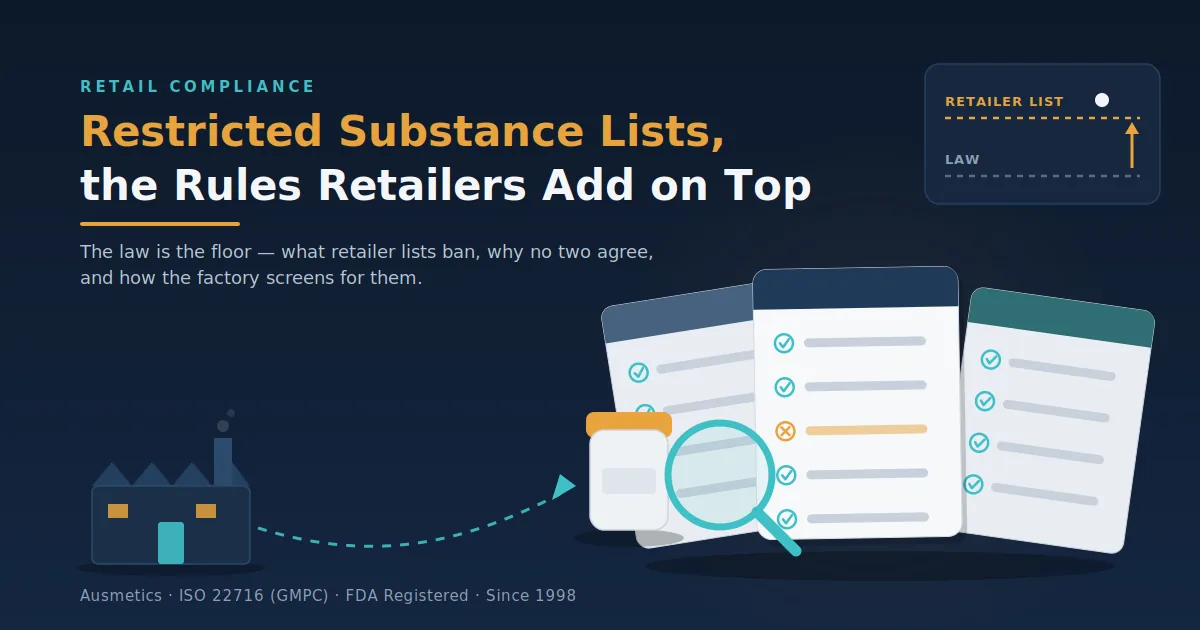
Una lista de sustancias restringidas (RSL) es un registro de ingredientes y productos químicos que un minorista o marca prohíbe o limita en los productos que vende, más allá de lo que la ley ya exige. El reglamento sienta las bases: solo el Reglamento sobre cosméticos de la UE prohíbe directamente más de mil sustancias y restringe cientos más. Pero para un producto que llega al lineal de un importante minorista, el suelo rara vez es la prueba que importa. La prueba que importa es la propia lista del minorista..
El instrumento creció en las cadenas de suministro de prendas de vestir., donde el Ropa americana & La Asociación del Calzado mantiene un RSL para toda la industria y el programa ZDHC regula la química de fabricación.. La belleza heredó tanto la herramienta como el vocabulario.. En el taller, el mismo instrumento tiene nombres más amigables: Clean en Sephora, Objetivo limpio, Belleza consciente en Ulta Beauty, pero debajo de cada insignia hay una lista, un conjunto de umbrales, y una obligación de control que recae sobre quien fabrica el producto.
Esta guía lee el RSL desde el lado de la oferta.: ¿Por qué los minoristas redactan normas privadas más estrictas que las públicas?, ¿Por qué no hay dos listas que coincidan?, y lo que se necesita dentro de una fábrica para que cada fórmula cumpla con todas ellas a la vez, escrita por un fabricante cuyas fórmulas se comparan con las listas de sustancias restringidas de los mercados y minoristas a los que presta servicios..
I. La ley es el piso, la lista del minorista es el techo
La lista de un minorista añade tres tipos de reglas además de la regulación. Excluye ingredientes que son legales en el mercado pero no deseados en el lineal.. Establece límites máximos y umbrales de trazas de contaminantes por debajo de cualquier cosa que solicite un regulador.. Y cada vez más va más allá de la fórmula, hacia la divulgación y el empaquetado.. El programa de Target es un claro ejemplo.: es política de productos químicos publicada compromete a la empresa a seguir listas de sustancias restringidas y a fabricar listas de sustancias restringidas en toda su gama, y su Lista de sustancias químicas prioritarias se centró en los ftalatos, propilo- y butilparabenos, formaldehído y donantes de formaldehído, y etoxilatos de nonilfenol en belleza y cuidado personal años antes de que cualquier estatuto lo requiriera.
¿Por qué un minorista debería regularse más a sí mismo que la ley?? Porque el nombre en el estante es el nombre que responde por el producto.. Los grupos de defensa califican públicamente a las cadenas en cuanto a la gestión de productos químicos (el Retailer Report Card ha clasificado a los principales minoristas exactamente en este aspecto durante años) y los tribunales se han convertido en parte de la presión.. Sephora ha defendido una demanda que alegaba que su etiqueta Clean at Sephora constituía publicidad engañosa., y en octubre 2025 una demanda colectiva alegaba que algunos productos de Conscious Beauty contenían ingredientes de la propia lista Made Without de Ulta.. Cualesquiera que sean los resultados, La lección para los equipos de abastecimiento es idéntica.: cuando una lista falla, el minorista lleva el fracaso. Por eso las obligaciones de control van en sentido ascendente: en los contratos con los proveedores., y de ahí a los SOP de fábrica, a través de los programas de marca propia que Las cadenas minoristas ahora las tratan como empresas emblemáticas..
II. Un producto, Muchas listas
Si las listas de minoristas fueran copias unas de otras, el cumplimiento sería una pantalla. ellos no son. Cada programa traza sus propias líneas., publica sus propios umbrales, y revisa en su propio calendario:
| Programa | Escala | que lo define |
|---|---|---|
| Limpiar en Sephora | Más que 50 ingredientes excluidos, actualizado anualmente desde 2018 | Permite ingredientes etoxilados solo con pruebas de contaminación para 1,4-dioxano y óxido de etileno.; su revisión más reciente extiende las exclusiones al embalaje |
| Belleza consciente en Ulta Beauty | "Hecho sin" lista de cinco pilares del programa | Publica umbrales de trazas numéricos: los límites para el 1,4-dioxano se encuentran por debajo 10 ppm para enjuague y bajo 3 ppm para productos sin aclarado |
| Objetivo limpio | Alrededor 5,000 artículos participantes al final del año 2024 | define "formulado sin" como debajo 100 ppm en el producto terminado; verificado libre de la Lista de sustancias químicas prioritarias objetivo desde enero 2023 |
| Estándar limpio Credo | Más que 2,700 ingredientes prohibidos | El extremo especializado del espectro: la lista más estricta, custodiando las puertas más pequeñas |
| Estándar de cuidado corporal de Whole Foods | Más que 180 ingredientes prohibidos | El pionero: comenzó con una lista de más de 100 hace más de una década y se ha ampliado desde entonces. |
Leer los desacuerdos, porque ellos son el punto. El aceite mineral supera Target Clean pero no cumple con la definición de limpieza de Sephora. Incluso "sin" es un objetivo en movimiento: Target lo define como en 100 ppm en todo el producto terminado, mientras que los límites publicados por Ulta para un solo contaminante, 1,4-dioxano, Siéntese a una décima parte de eso para productos que se enjuagan y más bajo aún para productos que no se aclaran.. "Obediente" por lo tanto no significa nada hasta que se nombre la lista (y su revisión actual). Un análisis de más de 8,000 Los productos de consumo del proveedor de software de cumplimiento SmarterX encontraron que casi la mitad de los artículos de maquillaje estaban en conflicto con al menos un minorista RSL., una medida de cuánta luz natural se encuentra entre el piso legal y los techos comerciales encima de él.
Para una fábrica que atiende varios programas a la vez, el cumplimiento es una matriz: cada SKU, contra cada lista aplicable, en la versión vigente este año.
III. RSL y MRSL, Dos preguntas diferentes
El lenguaje de adquisiciones establece una segunda distinción que vale la pena mantener clara. Una RSL restringe lo que puede quedar en el producto terminado.. A lista de sustancias restringidas de fabricación (MRSL) restringe la química utilizada para fabricarlo: ayuda al proceso, Agentes de limpieza y saneamiento, independientemente de si sobrevive o no en el frasco.. El concepto MRSL surgió del procesamiento húmedo de textiles bajo el programa ZDHC, y ha seguido a los minoristas hacia la mercancía general.: Target ha adoptado el ZDHC MRSL junto con sus listas de nivel de producto.
| RSL | MRSL | |
|---|---|---|
| Pregunta que responde | ¿Qué hay en el producto que un comprador se lleva a casa?? | ¿Qué química utiliza la fábrica para hacerlo?? |
| Contenido típico | Ingredientes prohibidos, límites de concentración, umbrales de trazas de contaminantes | Insumos de proceso prohibidos: disolventes, tropas auxiliares, agentes de limpieza |
| Pruebas que proporciona la fábrica. | Registros de detección de fórmulas, declaraciones de materias primas, informes de prueba del producto terminado | Inventarios de sustancias químicas del sitio, declaraciones de proveedores para materiales de proceso, hallazgos de auditoría |
Un único programa minorista puede invocar ambos instrumentos.. Un comprador que pregunta sobre su proceso RSL y un comprador que pregunta sobre la conformidad con MRSL preguntan sobre diferentes salas de la fábrica., y un proveedor que responde a una pregunta con la evidencia de la otra no ha respondido ninguna de las dos..
IV. Cómo se ve realmente la detección dentro de una fábrica
La selección comienza antes de la cotización., no después de la producción. La fórmula completa (incluidos los componentes de la fragancia y las impurezas conocidas de las materias primas) se verifica a nivel INCI con cada lista que se aplicará.. Cada, ni uno: Definición de Target por debajo de 100 ppm, Exclusiones de Sephora, y el manual de marcas propias de una cadena europea dibujan líneas diferentes en torno a una misma fórmula. Por un fabricante OEM de cosméticos ejecutar varios programas minoristas en paralelo, la pantalla es un paso firme en el desarrollo, no es un control final antes del envío.
El papel atrapa lo que se puso; Los instrumentos captan lo que vino.. Declaraciones de proveedores, fichas de datos de seguridad, y certificados de análisis para cada materia prima anclan la cadena de documentación, pero los trazas de contaminantes como el 1,4-dioxano nunca aparecen en la etiqueta de un ingrediente: se encuentran en un laboratorio o no se encuentran en absoluto.. Es por eso que sistemas de aseguramiento de la calidad con laboratorios físicos, químicos y microbiológicos internos llevan la carga de rutina, con verificación de terceros por parte de casas como Intertek, Oficina Veritas, y SGS en capas en la parte superior. Y algunas obligaciones se repiten por lote, no por fórmula: los laboratorios que prestan servicios a los programas Sephora y Ulta describen las comprobaciones de contaminantes como un trabajo lote por lote, una distinción que decide si un presupuesto de prueba es una partida individual o un error de redondeo..
El requisito menos glamuroso es el que separa a los proveedores: control de versiones. Las listas se mueven: Sephora las ha revisado anualmente desde 2018, y Target sigue ampliando el alcance de su programa. Una fórmula aprobada bajo una revisión puede fallar en la siguiente sin cambiar un solo gramo. Por lo tanto, una fábrica que atiende al comercio minorista necesita un mecanismo de activación permanente.: cuando se actualiza una lista, las fórmulas afectadas se vuelven a analizar, Se vuelven a declarar los proveedores de materias primas., y los resultados llegan al cliente antes que el auditor del minorista.. Este es el control de cambios que vive dentro de la relación con el proveedor., y es la pieza que con mayor frecuencia falta en las fábricas que tratan el RSL como una puerta de un solo uso..
V. Leer la preparación RSL de un proveedor como un comprador
En nuestra experiencia sirviendo programas minoristas, el sorteo nunca es el sí a "¿Puedes conocer nuestra lista?" - todos dicen que si. Es la evidencia detrás del sí.. Pregunte en qué parte del SOP de desarrollo se ubica la pantalla., y quien lo firma. Pregunte bajo qué programas con nombre ha fabricado la fábrica.. Pregunte cómo se recogen las declaraciones de materias primas, y ¿cuántos años tiene el más antiguo registrado?. pregunta que paso, concretamente, la última vez que llegó una revisión de la lista a mitad del programa.
La diligencia minorista finalmente comprueba dos expedientes. El archivo de personas - el Auditoría SMETA y sus hermanos: muestra cómo se fabrica el producto de forma responsable. El archivo de material: la pantalla RSL, las declaraciones, Los informes de prueba: muestran si el producto en sí puede llevar el nombre del minorista.. Una fábrica fuerte por un lado y silenciosa por el otro está medio cualificada, y los compradores minoristas rara vez apuestan por la mitad.
Preguntas frecuentes
¿Es una lista de sustancias restringidas legalmente vinculante??
No como estatuto: una RSL se vincula a través de la cadena comercial. Los acuerdos con proveedores y los términos de calidad hacen que el cumplimiento de la lista sea una condición contractual, con consecuencias que van desde lotes rechazados y devoluciones de cargo hasta la exclusión del programa. La ley todavía se aplica debajo.: un RSL nunca permite nada que la regulación prohíba; sólo reduce lo que permite la regulación, Precisamente por eso los compradores lo consideran la prueba más difícil..
¿Cuál es la diferencia entre un RSL y un MRSL??
Una RSL restringe lo que puede quedar en el producto terminado que un comprador se lleva a casa.. Un MRSL restringe la química utilizada para fabricarlo., incluidos auxiliares de proceso y agentes de limpieza que nunca aparecen en ninguna etiqueta. La combinación se originó en las cadenas de suministro de prendas de vestir y ha seguido a los minoristas hasta el sector de la belleza – Target, por uno, aplica ambos instrumentos conforme a su política sobre sustancias químicas publicada, junto con la industria ZDHC MRSL.
¿Un reclamo libre de significa que un producto cumple con la lista de un minorista??
No. Un reclamo libre de contenido es un lenguaje de marketing cuyo alcance define la marca.; La lista de un minorista es un documento con nombre y sus propias exclusiones., umbrales, y a menudo una definición numérica de "sin" — Objetivo limpio, Por ejemplo, define formulado sin para artículos de belleza y cuidado personal como en 100 ppm en el producto terminado. Honestamente, un producto puede tener un reclamo gratuito y aun así no estar en la lista que se encuentra junto a él en el estante..
¿Quién es responsable de volver a realizar una evaluación cuando se actualiza una lista??
Contractualmente, la marca o el minorista poseen el cumplimiento en su mercado. Operacionalmente, La nueva selección ocurre donde se encuentran las fórmulas y los archivos de materia prima: en la fábrica.. Los programas maduros plasman la mecánica en términos de proveedores: quién supervisa las revisiones de la lista, qué tan rápido se vuelven a verificar las fórmulas afectadas, y cómo se propagan los cambios a los proveedores de materias primas. Una fábrica sin una respuesta escrita a esas tres preguntas es un vacío a la espera de que una auditoría la encuentre.
Conclusión y próximos pasos
La ley es el piso.; la lista es la prueba. Las listas no están de acuerdo entre sí a propósito, revisar en sus propios calendarios, y llegar más lejos cada año: en la química de trazas, en embalaje, en las entradas del proceso propio de la fábrica. Y el control que decide si un producto puede llevar el distintivo de minorista no se realiza en la sede central. sucede en la fabrica, fórmula por fórmula, revisión por revisión.
Ausmetics ha estado en el lado receptor de esa prueba durante 28+ años desde su ISO 22716 (GMPC) certificado, Instalaciones auditadas por Sedex en Guangzhou: cada fórmula se compara con las listas de sustancias restringidas de los mercados y minoristas a los que presta servicios., con auditorías de terceros por parte de Intertek, Oficina Veritas, y SGS, e historial de auditoría minorista con cadenas del calibre de Tesco, Kmart, H&METRO, Guardián, y mannings. Tanto el archivo de materiales como el de personas se mantienen actualizados.. Los equipos minoristas de marcas propias y de suministro de marcas pueden revisar nuestra Servicios de fabricación de cosméticos OEM y ODM. o contacta con Ausmetics con la lista - la lista nombrada, versión y todo, y obtenga una respuesta a nivel de fórmula en lugar de un folleto.