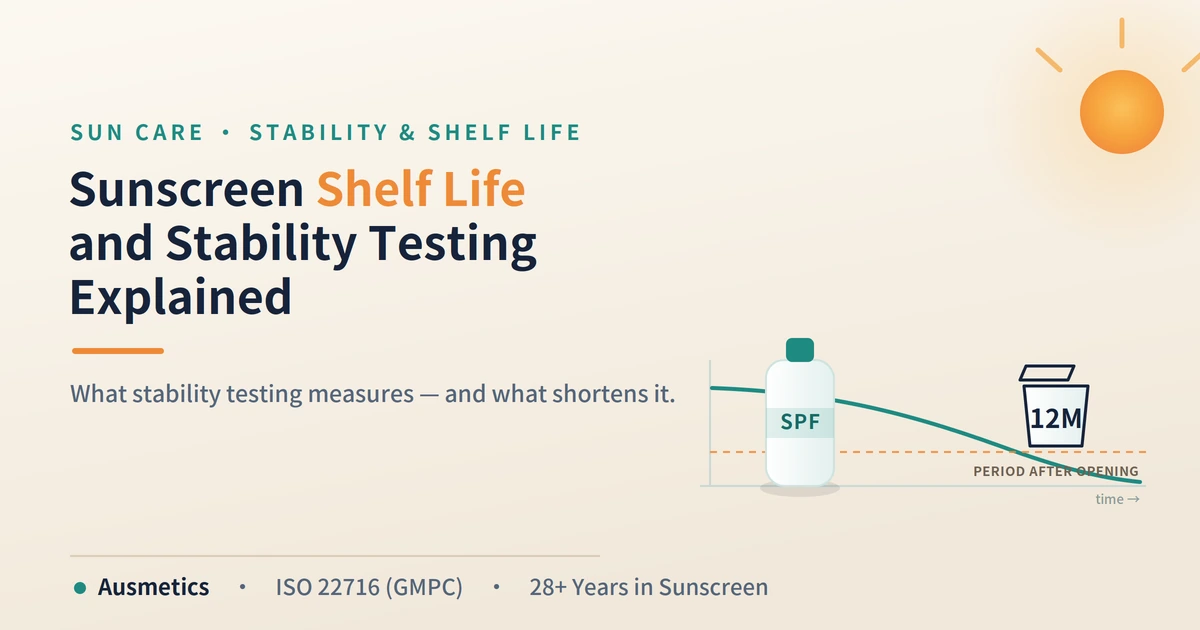
Sebagian besar artikel tentang umur simpan tabir surya ditulis untuk orang yang memiliki botol bekas di tas pantainya. Yang ini ditulis untuk orang yang memasarkan botol itu. Perbedaan itu penting, karena untuk sebuah merek, umur simpan tabir surya bukanlah fakta yang Anda cari - ini adalah hasil yang harus Anda hasilkan. Sejumlah seperti "tiga tahun" tidak berasal dari buku peraturan; itu berasal pengujian stabilitas tabir surya, proses yang membuktikan berapa lama formula spesifik Anda, dalam kemasan spesifik Anda, sebenarnya bertahan. Jika salah, Anda akan mengirimkan produk yang gagal sebelum tanggalnya, atau mencetak tanggal yang tidak dapat Anda pertahankan.
Panduan ini mencakup langkah-langkah pengujian stabilitas, yang memperpendek umur simpan tabir surya, dan bagaimana tanggal pada kemasan ditetapkan di pasar yang diatur oleh kosmetik. Ini adalah kebalikan dari pertanyaan apakah tabir surya melindungi atau tidak – yaitu tentang SPF, dan yang kami bahas secara terpisah dalam panduan kami cara kerja pengujian SPF. Stabilitas adalah separuh lainnya: bukan "apakah itu melindungi," Tetapi "apakah itu terus melindungi, dan tetap aman untuk digunakan, selama label mengklaim."
Catatan tentang ruang lingkup: ini ditulis untuk merek yang menjual tabir surya sebagai kosmetiknya — UE, Inggris, sebagian besar Asia, Amerika Selatan, Teluk, dan sebagian Afrika. Di pasar-pasar tersebut, umur simpan diatur oleh data stabilitas Anda sendiri dan ditampilkan sebagai tanggal terbaik sebelum atau simbol periode setelah pembukaan, bukan dengan aturan menyeluruh. (Pasar yang mengatur tabir surya sebagai obat, seperti Amerika Serikat, menangani kadaluwarsa secara berbeda, dan itu di luar panduan ini.)
SAYA. Mengapa Umur Simpan Merupakan Hasil Tes, Bukan Default
Angka yang sering diulang adalah bahwa tabir surya bertahan sekitar dua hingga tiga tahun. Ini adalah aturan praktis yang masuk akal untuk menyelesaikannya, produk yang dibuat dengan baik, tapi memang itulah yang terjadi - jempol di udara. Dimana angka tiga tahun diperlakukan sebagai aturan yang keras, hal ini biasanya ditelusuri kembali ke peraturan obat-obatan AS, yang bukan merupakan cara kerja pasar kosmetik. Di bawah Uni Eropa Peraturan Kosmetik dan kerangka kerja yang dimodelkan berdasarkan hal tersebut, umur simpan tabir surya tergantung pada pengujian stabilitas yang Anda lakukan, mengungkapkan salah satu dari dua cara: tanggal terbaik sebelum untuk produk yang bertahan lama 30 bulan atau kurang, atau simbol periode setelah pembukaan toples terbuka — the "12M" atau "24M" ikon — untuk produk yang bertahan lebih lama.
Perbedaan tersebut mempunyai konsekuensi praktis. Umur simpan Anda adalah klaim seperti klaim lainnya, dan itu harus dibuktikan. Cetak tanggal yang lebih panjang dari yang didukung data Anda dan Anda akan menghadapi masalah kepatuhan dan tanggung jawab; cetak yang lebih pendek dan Anda memaksa pelanggan untuk mengganti produk yang masih bagus, dan menghapus inventaris Anda lebih cepat dari yang diperlukan. Pengujian stabilitas adalah cara Anda menemukan tanggal di mana Anda benar-benar dapat bertahan.
II. Apa yang Sebenarnya Diukur oleh Pengujian Stabilitas
Pengujian stabilitas — dipandu secara internasional oleh ISO/TR 18811, kerangka kerja khusus kosmetik untuk itu — sudah selesai, produk yang dikemas melalui kondisi yang dimaksudkan untuk menuanya, dan memperhatikan kemungkinan terjadinya kesalahan pada tabir surya. Kegagalan-kegagalan itu terbagi dalam beberapa kelompok, dan tabir surya memiliki kandungan lebih banyak dibandingkan kebanyakan kosmetik karena merupakan emulsi yang mengandung filter UV aktif.
Yang pertama adalah penguraian fisik — pemisahan emulsi, teksturnya menipis atau menebal, perubahan warna, atau bau berubah. Inilah perubahan yang akhirnya dilihat konsumen, dan dokter kulit menunjukkan hal tersebut dengan tepat (perubahan warna, konsistensi, atau bau) sebagai tanda tabir surya sudah habis. Yang kedua adalah mikroba: apakah sistem pengawet menjaga produk tetap aman digunakan selama masa pakainya dan setelah dibuka berulang kali, yang dikonfirmasi oleh tes tantangan terpisah. Yang ketiga, dan yang khusus untuk tabir surya, adalah apakah produk tersebut masih memberikan perlindungannya — dan di situlah peran fotostabilitas.
Untuk mendapatkan jawaban dalam hitungan bulan, bukan tahun, pengujian berjalan di dua jalur. Pengujian waktu nyata menyimpan produk pada kondisi normal, sekitar 25°C, dan memeriksanya pada interval tertentu sepanjang masa pakainya. Pengujian yang dipercepat mendorongnya lebih keras — biasanya pada suhu 40°C, terkadang dengan siklus beku-cair — untuk mempercepat penuaan dan memprediksi hasil secara real-time. Jalur yang dipercepat inilah yang memungkinkan sebuah merek diluncurkan tanpa menunggu tiga tahun hingga kalender mengonfirmasi klaim tiga tahun.
AKU AKU AKU. Fotostabilitas — Mode Kegagalan yang Unik pada Tabir Surya
Di sinilah perbedaan tabir surya dengan pelembab. Tabir surya bisa terlihat, bau, dan merasa sempurna dan diam-diam masih kehilangan perlindungannya, karena beberapa filter UV rusak pada bagian yang seharusnya dibloknya: sinar matahari. Suatu produk dapat lolos dari setiap pemeriksaan fisik dan mikroba namun tetap gagal dalam pemeriksaan yang paling penting.
Ini sebagian besar merupakan pertanyaan tentang sistem filter, dan terhubung langsung ke mineral versus kimia keputusan. Filter mineral — seng oksida dan titanium dioksida — pada dasarnya dapat difoto. Banyak filter organik tidak; seperti yang dikatakan secara blak-blakan oleh seorang dokter kulit, pada dasarnya setiap bahan aktif selain seng oksida dan titanium dioksida relatif tidak stabil. Avobenzone adalah kasus buku teks: filter UVA kuat yang rusak di bawah sinar matahari kecuali jika dipasangkan dengan pasangan penstabil. Tidak satu pun dari hal ini yang mengesampingkan filter kimia – sebagian besar tabir surya modern menggunakannya dengan baik – tetapi ini berarti formulanya harus dibuat dan diuji untuk mempertahankan perlindungannya melalui paparan cahaya., tidak hanya diasumsikan. Pengujian fotostabilitas — biasanya dilakukan dengan mengukur perlindungan produk sebelum dan sesudah dosis sinar UV yang terkontrol, di bawah metode seperti ISO 24443 — adalah cara Anda memastikannya.
IV. Apa yang Sebenarnya Memperpendek Umur Simpan Tabir Surya
Ada dua kekuatan yang menentukan usia suatu produk sebenarnya, dan sebuah merek mengendalikan salah satunya sepenuhnya. Yang pertama adalah panas, lampu, dan kelembaban, yang disetujui oleh setiap sumber mempercepat degradasi — tabir surya yang ditinggalkan di dalam mobil yang panas atau terkena sinar matahari langsung akan terdegradasi jauh lebih cepat dibandingkan produk yang sama di dalam lemari. Sebuah merek tidak dapat mengontrol tas pantai pelanggan, tetapi ia dapat mengendalikan asumsi-asumsi yang diujinya, itulah sebabnya kondisi percepatan yang realistis penting bagi produk yang akan menghabiskan masa pakainya di tempat hangat.
Yang kedua adalah pengemasan, dan ini adalah bagian yang diremehkan oleh merek. Formula yang sama dapat memiliki umur simpan berbeda dalam kemasan berbeda, karena paparan udara dan kontaminasi mengubah usianya — dan format yang Anda pilih mempunyai pengaruh langsung dalam hal ini. Sebuah tongkat yang kokoh, Misalnya, hidup atau mati jika tetap stabil melalui panas dalam perjalanan, itulah salah satu alasan mengapa stik lebih sulit diformulasikan daripada kelihatannya; kami membahasnya dalam panduan kami untuk membangun lini tabir surya. Pompa tanpa udara melindungi emulsi rapuh lebih baik daripada botol terbuka. Pengujian stabilitas dilakukan pada produk jadi dalam kemasan sebenarnya karena alasan ini: tanggalnya termasuk dalam formula dan kemasannya bersama-sama, bukan rumusnya saja.
V. Apa Artinya Bagi Sebuah Merek
Pengujian stabilitas mudah dianggap sebagai kotak yang harus dicentang menjelang akhir pengembangan. Lebih baik dipahami sebagai ujian yang secara diam-diam menetapkan tiga hal: tanggal umur simpan yang dapat Anda klaim secara sah dan aman, seberapa jauh dan melalui kondisi apa Anda dapat mengirimkan dan menyimpan produk, dan seberapa besar risiko inventaris yang Anda tanggung jika penjualannya lebih lambat dari yang direncanakan. Umur simpan yang pendek atau rapuh bukan hanya sekedar batasan kepatuhan — ini adalah kendala pada keseluruhan distribusi Anda.
Itu juga mengapa pabrikan itu penting. Menghasilkan data stabilitas real-time dan dipercepat, menjalankan fotostabilitas dan pengujian tantangan, dan membaca hasil untuk menetapkan tanggal yang dapat dipertahankan adalah pekerjaan rutin bagi pembuat tabir surya yang berpengalaman dan merupakan sebuah kesenjangan bagi pembuat tabir surya yang kurang berpengalaman. Ausmetics telah memformulasikan dan menguji tabir surya untuk pasar yang diatur oleh kosmetik selama lebih dari 28 bertahun-tahun, di bawah ISO 22716 (GMPC), dengan upaya stabilitas dan fotostabilitas yang mendasari klaim umur simpan yang tertanam dalam cara suatu produk dikembangkan, bukan hanya sekedar terpaku pada akhirnya. Jika Anda ingin membicarakan formula dan kemasan apa yang dapat bertahan, itu adalah percakapan dengan Anda produsen tabir surya label pribadi lebih awal - tanggalnya jauh lebih murah untuk dirancang daripada ditemukan.
Pertanyaan yang sering diajukan
Berapa lama tabir surya bertahan?
Kebanyakan tabir surya yang sudah jadi diformulasikan untuk bertahan sekitar dua hingga tiga tahun tanpa dibuka, namun angka itu merupakan patokan umum, bukan aturan yang tetap. Umur simpan sebenarnya tergantung pada formulanya, filter UV, kemasannya, dan kondisi penyimpanan, dan untuk sebuah merek, hal ini ditentukan melalui pengujian stabilitas, bukan asumsi. Di pasar kosmetik, bahwa kehidupan yang diuji ditunjukkan sebagai tanggal terbaik sebelum atau simbol periode setelah pembukaan, dan paparan panas atau sinar matahari dapat mempersingkatnya jauh sebelum tanggal tersebut.
Apakah tabir surya lebih cepat kadaluwarsa setelah dibuka?
Itu bisa, itulah sebabnya produk kosmetik memiliki simbol periode setelah pembukaan — ikon toples terbuka dengan gambar seperti itu "12M" — di samping atau sebagai pengganti tanggal terbaik sebelum. Pembukaan membuat produk terkena udara dan potensi kontaminasi, dan penggunaan berulang dapat menekankan sistem pengawet, itulah yang diperiksa oleh pengujian tantangan. Pengemasan membuat perbedaan nyata di sini: pompa tanpa udara membatasi paparan ini jauh lebih baik daripada stoples bermulut lebar, jadi dua produk dengan formula yang sama bisa mempunyai open life yang berbeda.
Apa perbedaan antara pengujian stabilitas dan pengujian SPF?
Mereka menjawab pertanyaan yang berbeda. Pengujian SPF mengukur seberapa besar perlindungan yang diberikan tabir surya saat masih segar, sementara pengujian stabilitas mengukur apakah produk tetap efektif, aman, dan secara fisik sehat selama masa simpannya dan setelah paparan cahaya. Tabir surya membutuhkan keduanya: SPF yang teruji kuat tidak ada artinya jika formulanya terpisah atau filternya rusak sebelum tanggal kedaluwarsa. Fotostabilitas, bagian dari pengujian stabilitas, adalah jembatan di antara keduanya — hal ini menegaskan bahwa perlindungannya tetap bertahan dari sinar matahari di dunia nyata.
Apakah tabir surya mineral lebih stabil dibandingkan tabir surya kimia?
Dari segi filternya sendiri, secara umum ya. Seng oksida dan titanium dioksida bersifat fotostabil, sementara banyak filter organik tidak berfungsi dengan baik dan perlu diformulasikan dengan stabilisator untuk menjaga perlindungannya di bawah sinar matahari. Hal ini tidak menjadikan tabir surya kimia tidak stabil sebagai suatu kategori – tabir surya yang dibuat dengan baik akan tetap stabil – namun ini berarti stabilitasnya harus direkayasa dan diverifikasi melalui pengujian, bukan dianggap remeh.. Pilihan filter dan pekerjaan stabilitas merupakan keputusan yang saling terkait.
Bagaimana cara mengetahui apakah tabir surya sudah rusak??
Tanda-tanda yang terlihat adalah perubahan warna, tekstur, atau bau, dan pemisahan emulsi apa pun — seperti tabir surya, terasa, atau baunya sangat berbeda dari saat masih baru, itu harus diganti. Kerugian dari tabir surya adalah ia dapat kehilangan perlindungan tanpa adanya perubahan yang terlihat, karena degradasi filter tidak terlihat, itulah sebabnya merek mengandalkan pengujian stabilitas dan fotostabilitas daripada penampilan. Untuk produk jadi, menghormati tanggal yang dicetak dan menyimpannya jauh dari panas dan sinar matahari adalah panduan yang lebih aman.
Versi Singkat
Umur simpan tabir surya terlihat seperti tanggal sederhana pada kemasannya, namun dibalik itu ada ujian yang sebenarnya – atau memang seharusnya begitu. Pengujian stabilitas menentukan berapa lama formula dapat bertahan, fotostabilitas menentukan apakah perlindungan tersebut dapat bertahan dari sinar matahari, dan kemasan yang Anda pilih adalah bagian dari jawabannya, bukan detailnya. Untuk sebuah merek, tanggal itu bukanlah sesuatu yang diasumsikan pada tiga tahun dan harapan; itu adalah sesuatu untuk dirancang, tes, dan berdiri di belakang, karena diam-diam mengatur klaim Anda, pengiriman Anda, dan risiko Anda. Merek yang memperlakukannya seperti itu menghindari kejutan terburuk dalam kategori tersebut — produk yang masa berlakunya habis sebelum labelnya menyatakan seharusnya demikian.