O protetor solar invisível da Supergoop é um gel transparente vendido como primer de maquiagem. Beauty of Joseon's Relief Sun é um fluido leve em um tubo flexível que se tornou viral por não parecer nada na pele. Sal & Stone faz um rosto colorido posicionado ao lado da cultura do surf e da beleza limpa. Três produtos diferentes, três negócios diferentes – e o que os separa não é o número FPS ou o filtro UV. É o formato. O formatos de protetor solar uma marca escolhe é, na prática, a única decisão que molda a quem o produto se destina, como é a sensação, quanto custa, e como é difícil fazer. A maioria dos fundadores trata isso como um detalhe da embalagem. As marcas vencedoras agora trataram isso como estratégia.
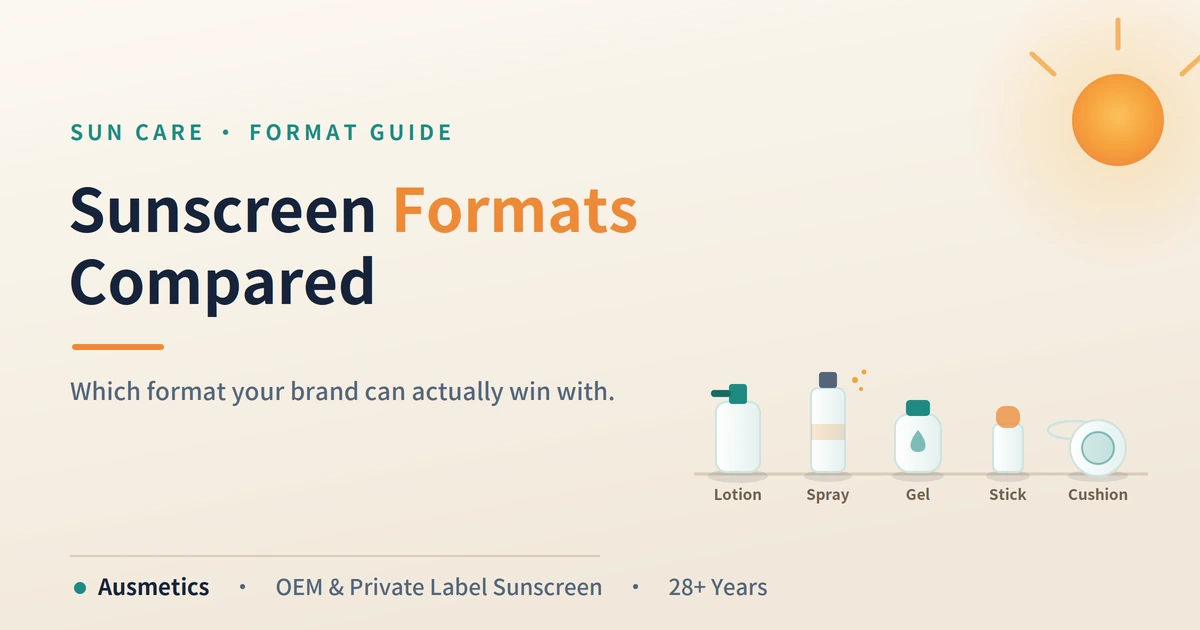
Este guia compara os principais formatos — loção, creme, gel, Spray, grudar, e a almofada que está surgindo silenciosamente - de uma perspectiva de construção de marca. Para cada um, as questões que importam são onde ele está no mercado, quem está ganhando com isso e como, e com o que isso o compromete. Se você estiver trabalhando com um fabricante de protetor solar de marca própria, o formato que você escolhe determina quase tudo no downstream.
Uma nota de enquadramento: isto foi escrito para marcas que vendem em mercados que regulamentam o protetor solar como cosmético - a UE, o Reino Unido, grande parte da Ásia, Ámérica do Sul, o Golfo, e partes da África. Todos esses formatos são comuns entre eles, embora algumas regras específicas de formato (aerossóis especialmente) variam de acordo com o mercado.
EU. Loção e creme ainda estão na prateleira - e esse é o problema
Loção e creme representam aproximadamente 54% do mercado de proteção solar em 2026, de acordo com Fortune Business Insights. Eles permanecem o padrão por um bom motivo: cobertura uniforme, compatibilidade com todos os tipos de pele, e a capacidade de transportar ativos para a pele – niacinamida, ácido hialurônico, antioxidantes – mais confortavelmente do que qualquer outro formato. Quase todos "FPS como último passo da sua rotina" posicionamento acaba aqui, e esse é precisamente o problema de uma nova marca: a prateleira já está cheia.
O crescimento dentro deste centro não ocorre com protetor solar simples. São os híbridos que confundem a linha entre o cuidado solar e a maquiagem básica. No Reino Unido, as vendas de tons de pele aumentaram 34% no ano até maio 2026, de acordo com Circana, acima de 14% no ano anterior. O presidente-executivo da Solésence, Kevin Cureton, fala sem rodeios: a tonalidade da pele está se tornando o hidratante diário dos consumidores de beleza, um único produto que oferece cobertura, cuidados com a pele, e FPS. Anastasia Beverly Hills lançou seu Hydra Prime no SPF 50, vendendo-o como primer em vez de protetor solar. A lição é que a loção vencedora em 2026 não está sendo vendido como uma loção – é um hidratante, uma cartilha, ou uma tonalidade de pele que proteja.
Para uma marca entrando neste espaço, a implicação é direta: uma loção FPS indiferenciada, por mais bem feito, é difícil de vender. Se loção for o formato, precisa de uma razão para existir além do FPS – uma história de cuidados com a pele, uma tonalidade, um jogo de textura — porque está competindo com milhares de outras válvulas que já funcionam bem.
II. Sticks – os mais difíceis de fazer, e o crescimento mais rápido no rosto
Se a loção é dona da prateleira, sticks possuem o impulso no rosto. Uma análise de mercado avalia o segmento de protetores solares faciais em aproximadamente $752 milhão em 2024, indo em direção $1.1 bilhões por 2034, e a lógica é simples: um pedaço de pau vai em um saco, reaplica sobre a maquiagem sem espelho, e viagens. Essa conveniência não é algo agradável de se ter. É a razão pela qual as pessoas reaplicam durante o dia, que é onde a maioria dos protetores solares falha na vida real.
O campo já está lotado o suficiente para ter níveis. CeraVe possui stick com ácido hialurônico e ceramidas, jogando o ângulo de reparo de barreira. Cetaphil lança um bastão mineral no FPS 50 destinado a peles sensíveis. Lagarto Azul domina crianças. Sal & Stone fica limpo, prêmio, território de estilo de vida ao ar livre. E Nívea, não é uma marca normalmente associada à K-beauty, lançou um Silky UV Stick que fabrica na Coreia e promove especificamente seu acabamento invisível e tecnologia coreana - um sinal de quanto o centro de gravidade do formato mudou em direção à Ásia.
Spate's 2026 relatório sobre cuidados solares coloca claramente a mudança: os cuidados solares específicos para o rosto estão mudando de sprays para bastões, soros, e estabelecendo névoas. Na Amazon nos EUA, "protetor solar em bastão coreano" desenha aproximadamente 3,000 pesquisas por semana, com os três principais produtos capturando quase 60% de cliques – demanda concentrada, mas ainda não está trancado.
Aqui está a abertura estrutural que torna os bastões especialmente interessantes para uma marca mais recente. Em vários relatórios do setor, uma linha consistente aparece: a participação de marcas próprias em sticks permanece limitada, porque o formato é genuinamente mais difícil de formular. Um protetor solar sólido deve permanecer firme durante o calor em um armazém ou contêiner de transporte, ainda deslize sem arrastar, e estabelecer um filme suficiente para entregar seu FPS avaliado. Formulações minerais em bastões — o segmento que mais cresce, com um relatório colocando o crescimento do bastão mineral em 62% - são ainda mais difíceis. Essa dificuldade é o fosso. Uma marca que consegue produzir um stick que funciona sem problemas e sobrevive ao trânsito de verão está competindo em um espaço que metade do mercado de marcas próprias evita. Do lado da embalagem, a barreira é baixa: contêineres de palito no atacado funcionam aproximadamente $0.13 para $0.58 uma unidade com mínimo em torno 1,000 para 10,000 pedaços. O custo não está no tubo. É fazer com que o bastão dentro dele realmente funcione.
III. Almofadas – o formato que a maioria dos guias sente falta
A entrada genuinamente nova que a maioria dos resumos de formatos ignora é a almofada de protetor solar – FPS líquido mantido em um estojo compacto embebido em esponja, emprestado direto da maquiagem K-beauty, pressionado sobre a pele para uma reaplicação sem sujeira, mesmo no rosto inteiro. Spate identifica almofadas como o mais recente formato K-beauty que está fazendo sucesso no mercado dos EUA, com TirTir e Laneige liderando. A mesma onda K-beauty foi o que levou a Beauty of Joseon às dez principais marcas de cuidados solares na Europa, de acordo com Circana.
Para uma marca, o apelo da almofada é o mesmo do stick, mas um passo adiante na curva de dificuldade: é diferenciado, É cedo, e é difícil fabricar bem, o que significa que o campo competitivo é escasso. Não é o primeiro produto para uma marca que está apenas começando – mas para alguém que está pronto para se destacar em um mercado lotado, é um movimento brusco, e um dos concorrentes que a maioria dos concorrentes ainda não está preparado para fazer.
4. Spray - honesto sobre o que faz e o que não faz
Spray é o formato corpo e conveniência, e está crescendo exatamente nisso: Fortune Business Insights observa que os sprays ganham participação com base na conveniência de uso, com produtos roll-on coloridos atraindo especialmente compradores mais jovens. O hábito de reaplicação que um spray permite é genuinamente valioso – é o que as pessoas procuram depois de nadar ou correr, o formato que transforma um produto descartável em rotina.
A captura honesta é uma lacuna de proteção no mundo real. Cada formato é testado quanto ao FPS na mesma dose – dois miligramas por centímetro quadrado, sob ISO 24444 - mas porque um spray é borrifado, as pessoas rotineiramente aplicam menos do que isso, e o vento fica com uma parte do que eles fazem. A proteção que um cliente realmente obtém com um spray pode rastrear o número na lata, não por causa da fórmula, mas por causa de como o formato é usado. (O lado do teste é abordado em detalhes em um guia complementar em como funciona o teste SPF.) Nada disso desqualifica o spray – significa que uma marca que vende um spray deve tornar as orientações de aplicação parte do produto, e posicioná-lo para o corpo e para reaplicação, em vez de como protetor solar facial primário. Spray também carrega peso operacional: o enchimento de aerossol é uma linha separada com custos próprios e etapas regulatórias em alguns mercados.
V. Gel e a mudança leve
Gel é à base de água, formato não oleoso que se adapta a peles oleosas e com tendência acneica e quentes, climas úmidos onde um creme rico é um fracasso. Está inserido em um movimento mais amplo que toda a categoria está realizando: texturas de proteção solar ficaram mais claras, mais transparente, e mais elegante, que é uma das principais razões pelas quais a absorção diária de FPS está aumentando. O aguado, "leitoso" As texturas K-beauty são a expressão mais clara – aquelas que fizeram as pessoas quererem usar protetor solar em vez de tolerá-lo.
Para uma marca, gel é mais uma ferramenta de posicionamento do que um jogo de volume. Sinaliza um público específico – pele oleosa, desgaste invisível, textura moderna – sem muita cópia, e permite que uma marca mais nova reivindique um segmento claro de clientes, em vez de lutar pela atenção de todas as loções multiuso. Ele traz menos alegações ricas em cuidados com a pele do que um creme, então trate-o como um formato que prioriza a sensação. Mas num mercado onde o sentir é cada vez mais o que vende um protetor solar, isso não é uma fraqueza.
VI. O que os dados somam
Leia juntos, a imagem é consistente. Loção e creme mantêm o volume — 54% do mercado - mas também o mais competitivo, e as marcas que crescem nesse espaço são as que vendem híbridos (matizes de pele, primers, hidratantes com FPS) em vez de protetor solar simples. O crescimento mais rápido e a diferenciação mais clara estão nas bordas: bastões e almofadas no rosto, sprays para o corpo, géis e fluidos leves para públicos específicos. E os formatos nas bordas são mais difíceis de fazer, que é precisamente o que os torna uma abertura – menos fabricantes se preocupam, então menos marcas competem lá.
Duas coisas que atrapalham os fundadores na escolha de um formato. Primeiro, formato e filtro são decisões separadas: se o seu protetor solar usa filtros UV minerais ou químicos é um eixo diferente que interage com o formato – os sistemas minerais são mais difíceis de manter invisíveis em um spray, por exemplo, e bastões minerais são mais difíceis de espalhar. Segundo, o formato define sua embalagem, ferramentas, quantidades mínimas de pedido, e custo por unidade, então ele precisa ser precificado desde o início, não descoberto mais tarde. O sequenciamento completo está no guia em como iniciar uma marca de protetor solar.
Para marcas que visam mercados regulamentados por cosméticos, a lição prática é escolher o formato que se adapta ao cliente - e então encontrar um fabricante com a profundidade de formulação para realmente torná-lo bem, especialmente se for um dos difíceis. A Ausmetics trabalhou em todos os principais formatos de protetor solar por mais de 28 anos, com triagem interna de FPS e ISO 22716 (GMPC) Produção, que permite que uma marca concorra em formatos onde a capacidade é escassa, em vez de se contentar com aquilo a que uma fábrica está limitada. Você pode explorar as opções com um experiente Fabricante de protetor solar OEM, ou fale com nossa equipe sobre qual formato se adapta ao seu.
Perguntas frequentes
Qual formato de protetor solar uma nova marca deve ser lançada primeiro?
Depende de onde uma marca deseja competir. Loção e creme seguram 54% do mercado, então eles oferecem volume, mas concorrência acirrada, e uma loção FPS indiferenciada é difícil de vender quando a prateleira já está cheia. Sticks e almofadas estão crescendo mais rápido e são mais fáceis de diferenciar, mas são mais difíceis de formular. A escolha mais forte combina o cliente-alvo com um formato que o fabricante pode realmente fazer bem - as marcas que estão se destacando no momento são aquelas que escolheram um formato, ficou excelente, e construímos a marca em torno dessa experiência.
O protetor solar em spray é tão eficaz quanto a loção?
Em teste, sim – cada formato é avaliado na mesma dose fixa sob ISO 24444, então um spray e uma loção com o mesmo FPS têm o mesmo desempenho no papel. Na prática, uma lacuna pode se abrir porque as pessoas tendem a aplicar menos spray do que a quantidade testada e o vento leva um pouco embora. Um spray protege tão bem quanto uma loção se o usuário aplicar uma quantidade generosa, camada uniforme e esfrega. Para marcas, isso significa que orientações claras sobre aplicação fazem parte da venda de um spray, não é uma reflexão tardia.
Os protetores solares são uma boa oportunidade para uma nova marca??
Eles podem ser fortes. O segmento de protetores solares faciais está avaliado em cerca de $752 milhões e projetado para $1.1 bilhões por 2034, com a participação de marcas próprias permanecendo limitada porque os bastões são mais difíceis de formular e manter estáveis no calor. Essa escassez cria uma abertura: uma marca cuja adesão se aplica uniformemente e sobrevive ao trânsito compete em um espaço que muitas outras evitam. A barra é a qualidade da formulação, não é orçamento de marketing, o que favorece marcas que escolhem cuidadosamente o seu fabricante.
Qual formato de protetor solar funciona melhor para pele oleosa?
Um gel ou fluido leve. Os géis são à base de água, absorver rapidamente, e são menos propensos a obstruir os poros, que se adapta a peles oleosas e com tendência a acne e quentes, mercados úmidos. A mudança mais ampla em direção à luz, "leitoso" As texturas K-beauty ficam no mesmo território. Para uma marca, um gel funciona como uma opção de conforto e um sinal claro de posicionamento – diz "para pele oleosa, desgaste invisível" sem muita cópia.
O formato altera o FPS do protetor solar?
Não. O FPS é medido em um valor fixo de aplicação, independentemente do formato, então o número testado reflete a fórmula, não se é uma loção, gel, Spray, ou pau. O que o formato muda é quanta proteção o usuário realmente obtém na prática, porque alguns formatos são mais fáceis de aplicar na íntegra, dose uniforme do que outras. Essa é uma diferença real na proteção fornecida, não há diferença no FPS avaliado.
Onde estão as aberturas
A prateleira ainda pertence a loções e cremes, e provavelmente sempre será. Mas as marcas que surgiram recentemente - Supergoop com um gel invisível vendido como primer, A beleza de Joseon com um fluido leve que se tornou viral em Feel Only, Sal & Pedra com um adesivo facial que sinalizava estilo de vida – tudo isso escolhendo um formato, tornando-o excelente, e construir uma marca em torno da experiência, em vez do número SPF. Os dados respaldam o padrão: o crescimento, o impulso social, e o espaço para diferenciar está nos formatos nas bordas, e esses formatos são os mais difíceis de fazer. Capacidade escassa é onde uma marca mais nova vence.