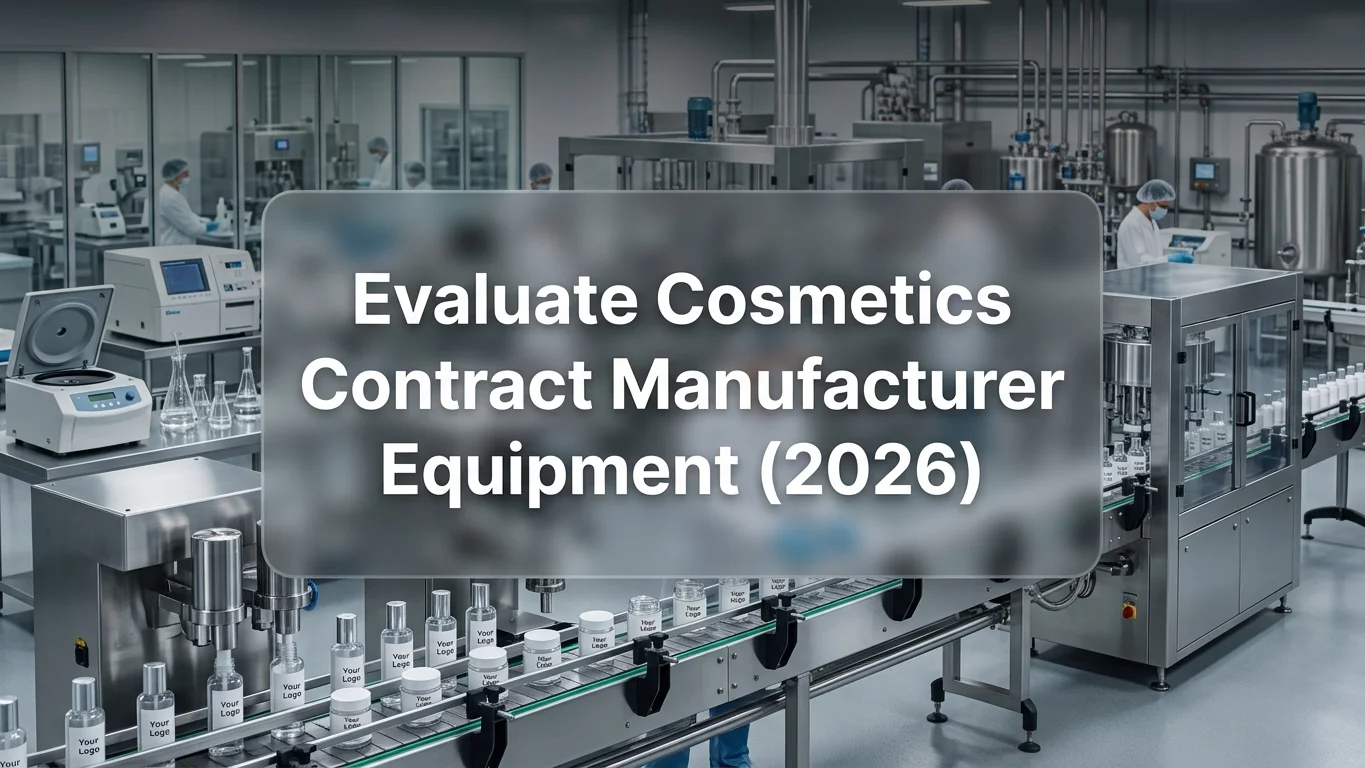
Choosing a cosmetics contract manufacturer often comes down to promises made during a sales presentation — sleek slide decks showing gleaming production lines, claims of million-unit monthly capacity, and assurances that batch consistency is “never a problem.” But once production begins, brand owners frequently discover a different reality: equipment that can’t handle their formulation viscosity, filling lines that produce unacceptable variance, or outdated packaging machinery that slows launches by weeks.
The gap between what a manufacturer claims and what their equipment can actually deliver is one of the most expensive lessons in the beauty industry. A single failed production run can cost a brand tens of thousands of dollars in wasted materials, missed retail deadlines, and damaged credibility. That’s why evaluating a manufacturer’s production equipment and technology before signing a contract is not optional — it’s foundational to your brand’s success.
This guide provides a structured, equipment-focused assessment framework you can use during factory visits, virtual audits, or RFQ evaluations in 2026. Whether you’re launching your first SKU or scaling an existing line across multiple categories, these criteria will help you separate manufacturers who invest in genuine production capability from those who rely on outdated machinery and manual workarounds.
I. Why Production Equipment Matters More Than You Think
A. The Direct Link Between Equipment and Product Quality
Every cosmetic product is only as good as the equipment that made it. A luxury serum with unstable emulsion, a sunscreen with uneven SPF distribution, or a lipstick with inconsistent color payoff — these failures almost always trace back to manufacturing equipment limitations rather than formulation errors.
Modern vacuum emulsification systems, for example, operate under controlled negative pressure to eliminate air bubbles and ensure particle size uniformity. According to the FDA’s Current Good Manufacturing Practice (CGMP) guidelines for cosmetics, equipment must be appropriate for its intended use and maintained to prevent contamination and ensure product consistency. Manufacturers still relying on open-kettle mixing simply cannot produce emulsions that meet 2026 consumer expectations for texture and stability.
The practical implication for brand owners is clear: during your evaluation, don’t just ask what equipment a manufacturer has — ask to see production records demonstrating how that equipment performs on formulations similar to yours.
B. Equipment Age and Maintenance as Leading Indicators
A factory tour may reveal impressive-looking machinery, but age and maintenance history tell the real story. Equipment that’s 15-20 years old may still function, but it typically lacks the precision controls, automated monitoring, and energy efficiency of current-generation systems.
Ask for the manufacturer’s equipment maintenance logs and capital expenditure records for the past three years. A manufacturer that consistently reinvests in technology upgrades signals long-term commitment to quality — not just short-term cost optimization.
Ausmetics Advantage: With 28+ years of cosmetics contract manufacturing experience since 1998, Ausmetics maintains a vertically integrated Guangzhou facility with continuous equipment investment cycles. The facility’s emulsification, filling, and packaging lines undergo scheduled upgrades to ensure they meet the evolving demands of 600+ global beauty brands across skincare, haircare, body care, and color cosmetics categories.
II. Critical Equipment Categories to Evaluate
A. Emulsification and Mixing Systems
The emulsification stage is where your formulation either comes together or falls apart. Here’s what to assess:
- Vacuum homogenizer capacity: Can the system handle your target batch sizes? Look for variable-speed homogenizers rated from 0 to 6,000+ RPM with programmable speed profiles.
- Temperature control precision: Heating and cooling jackets should maintain temperature within ±1°C. Ask for calibration certificates.
- Material compatibility: Tanks should be 316L stainless steel for acidic or high-salt formulations. Lesser grades corrode over time and contaminate products.
- Scale-up capability: If you plan to grow from 500-unit batches to 50,000-unit runs, the manufacturer needs multiple reactor sizes (e.g., 50L pilot, 500L mid-scale, 2,000L+ production) to scale without reformulation.
One practical test: ask the manufacturer to produce 5-10 unit pilot batch of your formulation and then measure viscosity, pH, and color consistency against your specification sheet. If they can’t hit your targets at pilot scale, production scale will only amplify the variance.
B. Filling and Dosing Lines
Filling accuracy directly impacts your cost per unit, regulatory compliance, and consumer trust. A filling line that consistently under-fills exposes you to labeling violations; one that over-fills erodes your margins on every unit shipped.
| Filling Technology | Best For | Typical Accuracy | Key Consideration |
|---|---|---|---|
| Piston fillers | Thick creams, lotions, pastes | ±0.5% by volume | Check cylinder wear and O-ring replacement schedule |
| Peristaltic fillers | Serums, toners, low-viscosity liquids | ±1% by volume | Tubing degradation affects accuracy over time |
| Servo-driven pump fillers | Wide viscosity range | ±0.3% by volume | Higher upfront cost but superior consistency |
| Gravity fillers | Water-like liquids | ±1.5% by volume | Least precise; unsuitable for premium products |
| Net-weight fillers | High-value products (e.g., anti-aging serums) | ±0.1-0.2% by weight | Gold standard for accuracy; verify scale calibration frequency |
During evaluation, request a fill-weight variance report from a recent production run. A well-maintained line running servo-driven or net-weight fillers should demonstrate standard deviation within acceptable limits across the entire batch — not just cherry-picked samples.
C. Packaging and Labeling Automation
Packaging lines are often where bottlenecks occur and where visible defects originate. Assess the following:
- Automated vs. manual capping: Manual capping introduces torque inconsistency, which can cause leaks during transit or shelf life failure.
- Vision inspection systems: Camera-based systems detect label misalignment, print defects, and missing components at speeds a human inspector cannot match.
- Serialization and batch tracking: If you sell through Amazon FBA, Sephora, or regulated EU markets, you need automated lot coding and potentially serialized QR codes on every unit.
The EU Cosmetic Regulation (EC No 1223/2009) requires batch traceability across the entire supply chain. Even if your primary market is North America, having automated batch tracking positions your brand for global expansion without requiring a manufacturing partner switch.
III. Technology Infrastructure Beyond the Production Floor
A. Laboratory and R&D Equipment
A manufacturer’s lab tells you whether they can develop, test, and validate formulations in-house — or whether they’re outsourcing critical steps that affect your timeline and intellectual property security.
Key lab equipment to verify during your assessment:
- Stability testing chambers — accelerated aging at 40°C/75% RH per ICH guidelines
- Particle size analyzers — laser diffraction or dynamic light scattering for emulsion characterization
- Rheometers — for viscosity profiling across temperature and shear rate ranges
- Microbiological testing equipment — challenge testing, preservative efficacy testing (PET), and total plate count capability
- Spectrophotometers — for color matching and batch-to-batch color consistency verification
An experienced cosmetics contract manufacturer with full in-house lab capability can iterate on formulations faster, catch stability issues before production, and protect your proprietary formulas within a controlled environment.
Ausmetics Advantage: Ausmetics’ R&D division, led by Dr. Jadir Nunes — former Global President of the International Federation of Societies of Cosmetic Chemists (IFSCC) and ex-Johnson & Johnson researcher — operates advanced laboratories equipped for full formulation development, stability testing, and microbiological validation. This in-house capability allows brands to move from concept to production-ready formula without relying on third-party labs, reducing both timelines and IP exposure risk.
B. Environmental Controls and Cleanroom Standards
Production environment quality matters as much as the equipment itself. The ISO 22716 Good Manufacturing Practices standard for cosmetics specifies requirements for air quality, temperature, humidity, and contamination prevention in production areas.
During your assessment, ask these questions:
- What is the cleanroom classification for the filling area? (ISO Class 7 or 8 is standard for cosmetics; higher-end products may require Class 6.)
- How is positive air pressure maintained to prevent external contamination?
- What is the HVAC filtration rating and replacement frequency?
- Are production zones segregated by product type (e.g., color cosmetics separate from skincare) to prevent cross-contamination?
Manufacturers who invest in proper environmental controls demonstrate they understand that equipment alone doesn’t ensure quality — the entire production environment must work as an integrated system.
IV. The Brand Owner’s Production Equipment Assessment Checklist
Use this checklist during factory visits, virtual audits, or when reviewing manufacturer capability documents. Score each area and compare across potential partners.
| Assessment Area | What to Request | Green Flag | Red Flag |
|---|---|---|---|
| Emulsification systems | Equipment specifications, batch records | Vacuum homogenizers with programmable profiles | Open-kettle mixing with manual temperature monitoring |
| Filling accuracy | Fill-weight variance reports from recent runs | Standard deviation ≤0.5% with automated lines | No variance data available; “trust us” responses |
| Batch tracking | Demonstration of lot code assignment workflow | Automated serialization with digital records | Handwritten batch logs or no traceability system |
| Lab capabilities | Equipment list, testing protocols, staff credentials | Full in-house stability, micro, and analytical testing | All testing outsourced to third-party labs |
| Cleanroom environment | ISO classification certificates, HVAC records | ISO Class 7-8 filling rooms with positive pressure | No environmental classification; open production areas |
| Maintenance records | Equipment maintenance logs, calibration certificates | Scheduled preventive maintenance with documentation | Reactive maintenance only; no calibration records |
| Scale-up pathway | Equipment range from pilot to full production | Multiple reactor and filler sizes for staged scale-up | Single production size; no pilot capability |
| Certifications | ISO 22716, GMPC, FDA registration, audit reports | Current certifications with recent audit dates | Expired certifications or refusal to share documentation |
Actionable recommendation: Create a weighted scoring system based on your brand’s priorities. If you’re launching skincare products with active ingredients that require precise temperature control, weight emulsification capability higher. If you’re running a high-volume Amazon FBA operation, weight filling speed and accuracy higher.
V. Questions to Ask During Factory Audits (With Expected Answers)
A. Equipment-Specific Questions
Most brand owners know they should audit a factory, but few know what questions to ask about equipment — and more importantly, what the right answers sound like. Here are five critical questions with benchmark responses:
- “What is the age of your primary emulsification equipment, and when was it last upgraded?” — Good answer: specific dates, upgrade details, and reasoning. Poor answer: vague timelines or “it’s relatively new.”
- “Can you share fill-weight variance data from a production run within the last 90 days?” — Good answer: specific data with standard deviation figures. Poor answer: “Our QC team handles that; we don’t share those reports.”
- “What is your changeover time between different product types on the same line?” — Good answer: specific time ranges with cleaning validation protocols. This directly impacts your lead time, especially for multi-SKU orders.
- “What happens if a filling line goes out of calibration mid-run?” — Good answer: automated alert systems, quarantine protocols for affected units, recalibration procedures. Poor answer: silence or confusion.
B. Technology and Data Management Questions
In 2026, manufacturing technology extends beyond physical machinery. Ask about:
- ERP and MES systems: Does the manufacturer use enterprise resource planning or manufacturing execution software to track orders, inventory, and production in real time?
- Digital batch records: Paper-based records are prone to errors and difficult to audit. Digital systems provide timestamped, tamper-evident documentation.
- Customer portals: Can you track your order status online, or are you relying on email updates from a sales representative?
A leading cosmetics contract manufacturer will have integrated digital systems that give you visibility into your production without requiring constant follow-up communication.
VI. How to Validate Equipment Claims Without Being an Engineer
A. The Pilot Run Test
The single most reliable way to evaluate a manufacturer’s equipment capability is to commission a paid pilot run. This isn’t a free sample — it’s a controlled test production that reveals how the equipment handles your specific formulation at small scale.
During the pilot run, evaluate:
- Does the final product match the lab sample in texture, color, viscosity, and fragrance?
- What is the fill-weight variance across the pilot batch?
- How does the packaging look? Are labels aligned? Are caps torqued consistently?
- How long did the run take versus the quoted timeline?
B. Third-Party Audit Reports
If an in-person factory visit isn’t feasible, request third-party audit reports. Sedex SMETA audits, for example, evaluate not only labor practices but also site conditions and management systems. ISO 22716 audit reports specifically address manufacturing equipment suitability and maintenance.
Ausmetics’ facility, for instance, maintains current ISO 22716, GMPC, FDA registration, and Sedex audit credentials — each independently verified by accredited third-party auditors. These reports provide objective equipment and facility assessments that supplement your own evaluation.
Frequently Asked Questions
What production equipment should a cosmetics contract manufacturer have at minimum?
At minimum, a capable cosmetics contract manufacturer should operate vacuum emulsification systems (not open-kettle mixers), automated or semi-automated filling lines with documented accuracy specifications, capping machines with torque control, labeling equipment, and a quality control laboratory with stability testing chambers, pH meters, viscometers, and microbiological testing capability. For brands requiring private label cosmetics, the manufacturer should also have packaging flexibility to handle various container formats — pumps, dropper bottles, tubes, jars, and airless dispensers.
How can I verify a manufacturer’s equipment claims if I can’t visit the factory in person?
Request a live virtual factory tour via video call where you guide the camera to specific equipment areas rather than following a pre-planned route. Ask for equipment specification sheets, recent calibration certificates, and maintenance logs. Commission a paid pilot run and have samples tested by an independent laboratory. Review third-party audit reports such as ISO 22716 certification documents and Sedex SMETA reports, which include facility and equipment assessments conducted by accredited auditors. Finally, ask for references from current clients who produce similar product types.
How important is automated batch tracking for my brand?
Automated batch tracking is essential for regulatory compliance, recall readiness, and market access. The EU Cosmetic Regulation requires full traceability, and major retailers like Sephora, Ulta, and Amazon increasingly require lot-coded inventory. Automated systems assign unique batch identifiers, record production parameters in real time, and create a digital audit trail that links every finished unit to its raw material sources. Without this capability, your brand faces significant risk if a product issue arises and a targeted recall becomes necessary — you’d have to recall entire product lines rather than specific affected batches.
What’s the difference between evaluating equipment for skincare versus color cosmetics?
Skincare evaluation prioritizes emulsification precision (particle size consistency, temperature control), filling accuracy for varying viscosities (thin serums to thick creams), and stability testing equipment for active ingredient verification. Color cosmetics evaluation focuses on color matching capability (spectrophotometers), grinding and milling equipment for pigment dispersion, pressing equipment for powders and compacts, and mold-filling precision for lipstick and stick products. A manufacturer producing both categories should have dedicated or thoroughly cleaned lines to prevent cross-contamination between pigmented and non-pigmented products.
How often should a manufacturer’s production equipment be calibrated?
ISO 22716 guidelines require that measuring and testing equipment be calibrated at defined intervals using traceable standards. In practice, critical equipment like filling machines, scales, and temperature sensors should be calibrated at least quarterly, with high-use filling lines calibrated monthly or even weekly. The manufacturer should maintain calibration logs with dates, results, and the name of the technician who performed the calibration. If a manufacturer cannot provide these records, it indicates either poor documentation practices or infrequent calibration — both are legitimate concerns for brand owners.
Conclusion and Next Steps
Evaluating a cosmetics contract manufacturer’s production equipment and technology isn’t about becoming a manufacturing engineer. It’s about asking informed questions, requesting specific documentation, and knowing what the answers should look like. The framework in this guide — from emulsification system assessment to batch tracking verification — gives you a structured approach that separates genuinely capable manufacturers from those that look impressive on a sales call but underdeliver in production.
The most important takeaway: never sign a manufacturing contract based solely on quoted prices and lead times. Equipment capability determines whether those promises translate into products your customers trust and repurchase. A manufacturer’s willingness to share variance data, maintenance records, and calibration certificates tells you as much about their culture as it does about their machinery.
If you’re ready to work with a trusted cosmetics contract manufacturing partner with 28+ years of production experience, ISO 22716 certification, FDA registration, and IFSCC award-winning R&D leadership, explore how Ausmetics supports brands from formulation development through full-scale production. Contact the Ausmetics team to discuss your product requirements and schedule a facility assessment.